In September 2026, the Dubai Land Department is rolling out its "Rent Now, Pay Later" service, letting eligible tenants spread their annual rent over twelve interest-free instalments, with the landlord paid in advance by a partner bank.
On this page
The Dubai Land Department (DLD) is preparing to launch, in September 2026, a service called "Rent Now, Pay Later" that will allow eligible tenants to spread their annual rent over a maximum of twelve monthly instalments, interest-free. The mechanism, revealed in mid-August 2026 by the local Emirati press and picked up by several business outlets, relies on a partner bank: it pays the landlord the full annual rent upon signing, after which the tenant repays the bank in monthly instalments. According to the first descriptions of the scheme, Dubai would become one of the first cities to roll out such a model across an entire rental market.
Key takeaways
- The Dubai Land Department (DLD) plans to launch the "Rent Now, Pay Later" service in September 2026, in partnership with a local bank.
- The scheme lets eligible tenants spread their annual rent over a maximum of twelve monthly instalments, with no interest whatsoever.
- Under this mechanism, the partner bank pays the landlord the entire annual rent up front, after which the tenant repays the bank month by month.
- The service was revealed in mid-August 2026 by the Emirati press, notably the daily Emarat Al Youm, ahead of its planned rollout in September 2026.
- Dubai has traditionally paid rent through one to four annual cheques, a practice this scheme aims to make more flexible.
How the "Rent Now, Pay Later" scheme works
The principle comes in three steps. The tenant selects a property, the partner bank pays the landlord the full annual rent upon signing, then the tenant repays the bank in equal monthly instalments over a period of up to twelve months, interest-free. The landlord, for their part, collects the equivalent of a full year's rent from the outset, just as if they had received a single annual cheque.
This approach breaks with Dubai's long-standing practice, where rent is paid through one to four post-dated cheques covering the year. That custom demands significant liquidity on the tenant's side and makes handling missed payments harder for the landlord. By inserting a bank into the equation, the DLD shifts the credit risk onto the lender and smooths the burden for the resident, while preserving the annual-payment logic that underpins the market.
As of the publication date, the exact eligibility criteria, the list of participating banks and any potential processing fees have not been publicly detailed. We will be following these parameters closely, as they will determine the real scope of the scheme once it comes into force.
Why it matters for Dubai's rental market
The stakes go beyond tenant convenience. By securing the annual payment for the landlord and lowering the liquidity barrier for the tenant, the mechanism mechanically widens the pool of creditworthy applicants. A household able to cover a monthly payment, but not a lump-sum annual cheque, becomes an accessible tenant for the landlord.

This measure is part of a series of DLD initiatives aimed at streamlining and digitising the rental relationship in Dubai. For investors who own a property intended for letting, the appeal lies in the steadiness of cash flow and the reduced risk of vacancy: the broader the pool of creditworthy tenants, the faster a property can be re-let. Areas with high tenant turnover, like the Dubai residential market as a whole, are the first to be affected.
What it changes for investors
For a landlord, the main advantage is securing the cash flow. With the annual rent paid up front by the bank, the owner regains the simplicity of the annual cheque without bearing the risk of default, which sits with the partner institution. This can translate into more predictable income and, indirectly, into reduced pressure on rental vacancy, since more applicants become eligible. We see it as a factor that supports net returns, without guaranteeing any level of yield, which always depends on the property, the neighbourhood and the market cycle.

It's worth recalling the tax framework that makes these flows so clear: in Dubai, individuals pay no tax on rental income or on property capital gains. Rent that is better spread and better guaranteed therefore directly improves the net cash flow the owner receives. What remains is to fit this scheme into a coherent rental management strategy: choice of manager, the trade-off between long-term and short-term lets, and control of running costs.
At Lucretia, we support our clients from selecting the property to putting it on the rental market, factoring in these regulatory developments. For a first purchase, careful attention to the structure — from the off-plan payment plan to the choice of tenant — remains decisive, and is one of the mistakes to avoid that we map out with every investor.
Source: timeoutdubai.com — 2026-09-01
Free guide, delivered on WhatsApp
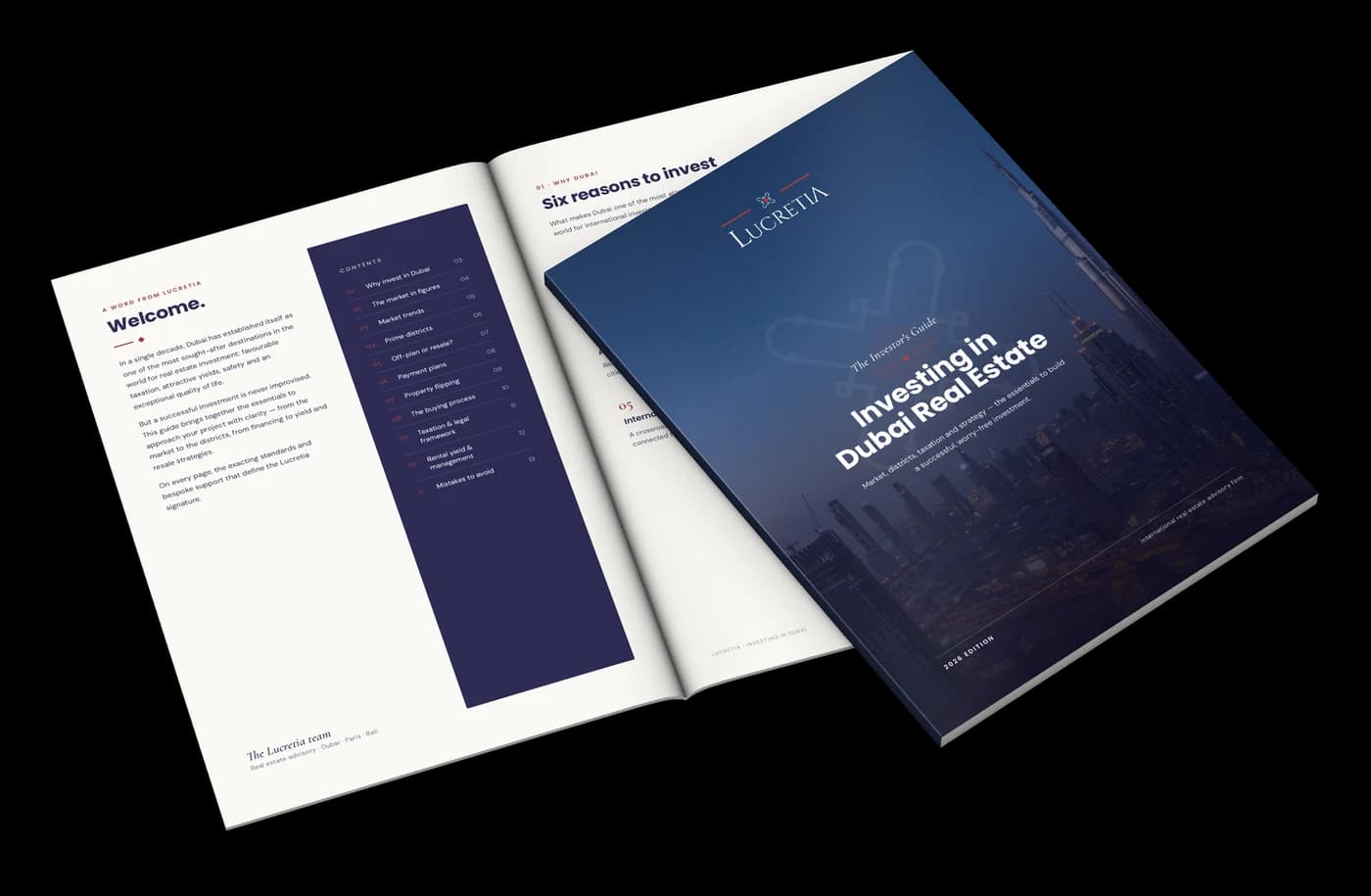
Get the guide "Investing in Dubai"
Taxation, visas, financing, buying steps: 14 pages written by our advisers, sent to your WhatsApp within minutes.
This article is part of our guide
Dubai Property Investment Guide for Foreign Buyers
About the author

Jean-Pierre MARTINI
Director of Technology & Innovation
With over 15 years of experience in corporate strategy, marketing and project management, Jean-Pierre has helped dozens of companies with their business development across several industries. An entrepreneur by training, he founded and led several companies, ranging from specialized retail to innovative digital solutions. Since 2021, he has turned his focus to real estate and the Dubai market, advising investors on their wealth strategies. Currently at Lucretia, his role includes managing technological innovation, optimizing business processes, and developing team skills. He also ensures client follow-up and provides personalized strategic advice to investors.