
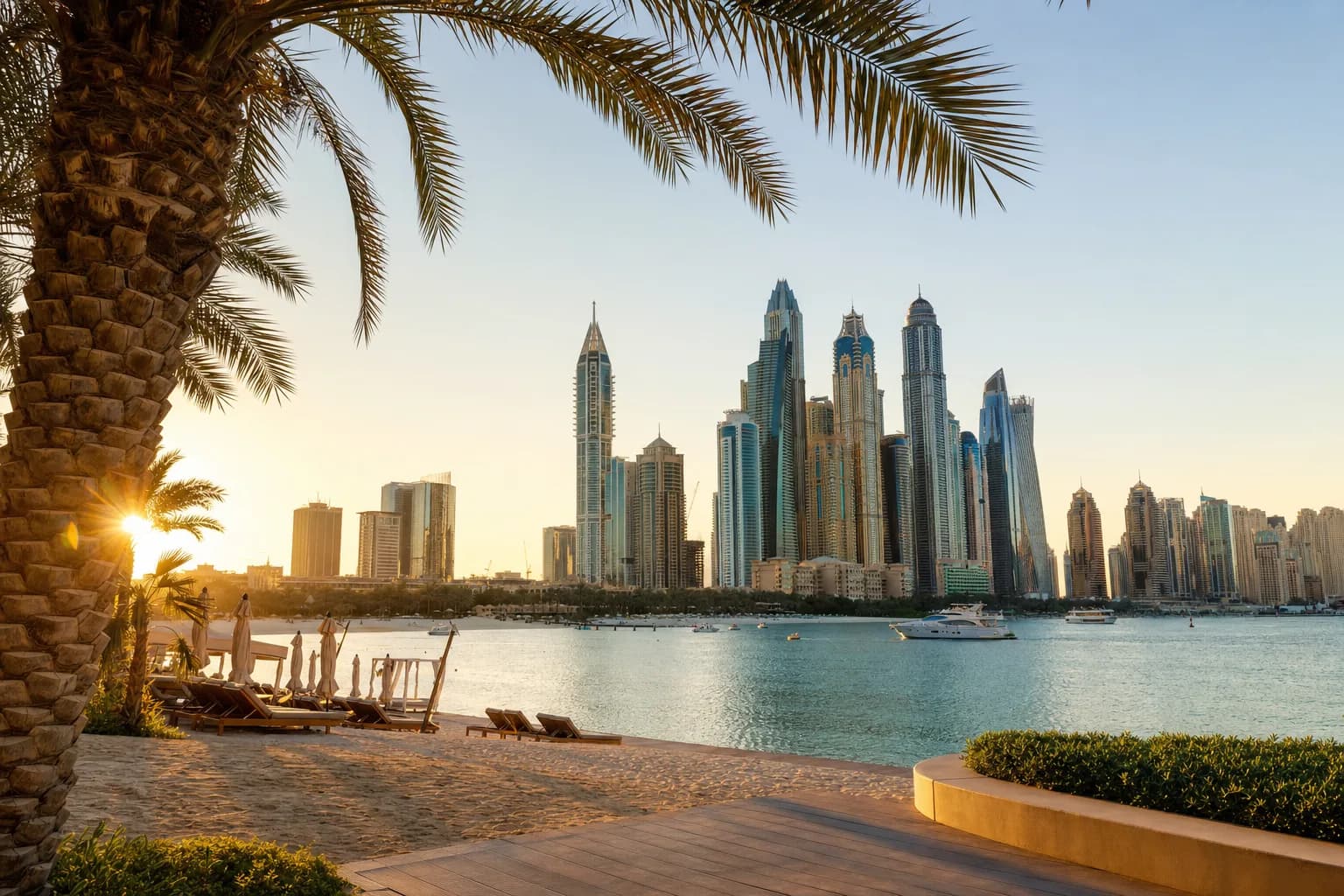
Tax, freehold, Golden Visa, yields, districts, buying process: everything an international investor needs to master before buying in Dubai.
On this page
- What taxes does a property investor in Dubai actually pay?
- Buying resale property in Dubai: the process for a completed home
- Legal framework for property ownership in Dubai: freehold and permitted zones
- Property types in Dubai: apartment, villa or townhouse to invest
- Managing your rental property in Dubai: property management and charges
- Mistakes to avoid when investing in Dubai
- Investing in Dubai or Bali: which market for which profile
- Rental yield in Dubai: what to really expect
- Where to invest in Dubai: choosing the right district for your objective
- Buying off-plan in Dubai: the process step by step
- Dubai Golden Visa through property: conditions and steps
- Financing a property purchase in Dubai: mortgage and down payment for non-residents
- Dubai's property market: trends and outlook
- Investing in Dubai by budget: what you buy at each price level
- Buy-to-sell strategies in Dubai: making a capital gain
- Dubai's up-and-coming districts: where to buy before the rise
- Luxury real estate in Dubai: branded residences and exceptional villas
- Choosing your developer in Dubai: reliability, guarantees and deliveries
- Buying in Dubai from abroad: the remote process
- Dubai's established districts: where to buy in safe addresses
This Dubai property investment guide starts from a rare fact: individuals pay no tax on rental income or capital gains here (official UAE government portal), with acquisition costs limited to 4% of the price paid to the Dubai Land Department and gross rental yields of 5 to 8% depending on the district. In 2025, the market recorded nearly AED 917 billion in transactions and more than 100,000 new investors, according to the Dubai Land Department.
The challenge is turning these advantages into a buying decision: which district, which type of property, off-plan or resale, with or without financing, and for which wealth objective. We bring together here every piece of the equation, with up-to-date figures and the concrete benchmarks we use daily to guide our clients from strategy to handover.
What taxes does a property investor in Dubai actually pay?
In Dubai, an individual who owns a property in their own name pays neither tax on rental income nor capital gains tax: the personal income tax rate is 0% (official UAE government portal). This is the starting point for any profitability calculation here, and the main difference from most European markets.
VAT doesn't change the picture for residential property: the sale and rental of homes are taxed at 0%, versus 5% on commercial real estate, according to the Federal Tax Authority. Buying an apartment to rent it out therefore triggers no VAT on the rent you collect.
The 9% corporate tax, in force since June 2023, applies only to profits above AED 375,000 earned by a company. An individual holding their property directly is not affected: the question only arises if you house the investment in a corporate structure, a trade-off we assess case by case. For the full picture of what property investors actually pay in Dubai — from transfer fees to service charges, inheritance and the home-country tax side — see our dedicated guide.
One final wealth-planning point deserves attention: by default, local succession rules may apply. For non-Muslims, a will registered with the DIFC Courts secures the transfer of assets and ensures your wishes take precedence over the default devolution.
Buying resale property in Dubai: the process for a completed home
Buying an already completed property in Dubai follows a well-marked path: signing a preliminary agreement (Form F / MOU), obtaining the developer's no-objection certificate, then transferring ownership at the Dubai Land Department against payment of the 4% fee. The whole process usually wraps up within a few weeks once financing is in place — we set out each stage in our dedicated guide to the resale buying process for a completed home.
Agency fees on the resale market amount to 2% of the price, plus 5% VAT, borne by the buyer under the RERA framework reported by Property Finder. On a one-bedroom in Business Bay, listed at AED 2,445/sq ft according to Bayut data (February 2026), these fees add to the DLD's 4% within your acquisition budget.
The key steps of the transfer
- The Form F (MOU) sets the price, timeline and deposit between buyer and seller.
- The seller obtains the NOC from the developer, confirming there are no unpaid charges.
- The transfer is signed at the trustee office, where the new title deed is issued.
The advantage of resale: you see the actual property, its building, its state of upkeep, and you collect rent immediately. The trade-off lies in the entry ticket, often higher than off-plan, and the absence of a staggered payment plan.
A rented property can be sold with its tenant in place: the Ejari lease transfers, guaranteeing you income from handover. Checking the lease's expiry date and current rent is part of the due diligence we conduct before any offer.
Legal framework for property ownership in Dubai: freehold and permitted zones
A foreign investor can own property outright (freehold) in Dubai's designated zones, a right opened up in 2002 by the Dubai Land Department. You then own both the home and the land, with no time limit, backed by a title deed in your name — we set out exactly what full foreign property ownership through freehold really guarantees in our dedicated guide.
Freehold stands in contrast to leasehold, a right of use for a limited term. Almost all the districts that appeal to international investors — from Downtown Dubai to Palm Jumeirah — are freehold, which explains the fluidity of the resale market.
The framework also protects the buyer upstream. For off-plan projects, Law No. 8 of 2007 requires escrow accounts supervised by the DLD: the funds paid are released to the developer only as construction progresses. This mechanism is the main safeguard of off-plan, which we return to further on.
Finally, every lease is registered via Ejari, the official rental register. This formality conditions access to public utilities and gives a legal basis to the landlord-tenant relationship.
Property types in Dubai: apartment, villa or townhouse to invest
Three broad families of property are open to investors in Dubai: the apartment, the villa and the townhouse, each with a distinct yield/entry-ticket pairing. The apartment dominates dense districts and posts the best gross yields; the villa targets capital appreciation and families.
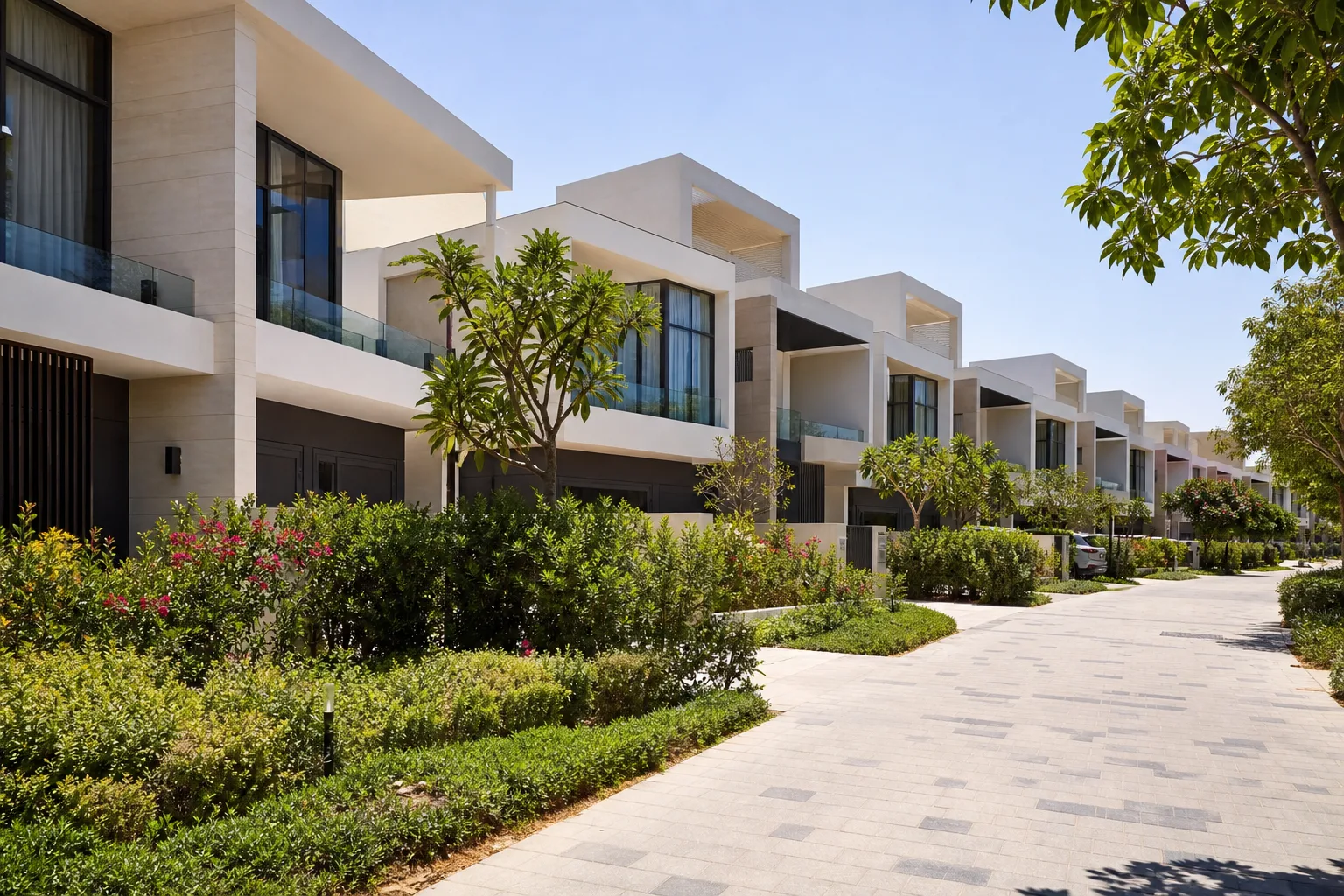
The apartment remains the most accessible entry point. In a district like Arjan, the average price comes to AED 1,485/sq ft for a calculated gross yield of 7.1%, according to Bayut data (March 2026). Charges here are concentrated on the building's common areas.
The villa plays a different tune. In Damac Hills, the average price reaches AED 1,616/sq ft for a gross yield of 6.5% according to Bayut data (March 2026), with structurally lower service charges (on the order of AED 2 to 6/sq ft/year across the market). The total ticket is higher, but the space and land support appreciation.
| Property type | Target profile | Yield benchmark |
|---|---|---|
| Apartment | Rental yield, accessible ticket | Arjan 7.1% (Bayut, March 2026) |
| Villa | Families, capital appreciation | Damac Hills 6.5% (Bayut, March 2026) |
| Townhouse | Space/price compromise, family rental | By community |
The townhouse sits between the two: more space than an apartment, a lower price than a standalone villa, and solid family rental demand in residential communities. The choice comes down to your objective — immediate cash flow or medium-term capital gain — which we frame from the wealth review onward, weighing yield, entry price and management burden in our guide to which property type to invest in between apartment, villa and townhouse.
Managing your rental property in Dubai: property management and charges
The main recurring cost for a Dubai landlord is the service charge, ranging from AED 3 to 30 per square foot per year depending on the property type, regulated by RERA via the Mollak platform (RERA / DLD Service Charge Index). This is the figure that turns an appealing gross yield into a realistic net yield.
The orders of magnitude differ sharply by property: roughly AED 10 to 20/sq ft/year for a standard apartment, 20 to 50 and up for a luxury tower, 2 to 6 for a villa. On a premium tower apartment in Downtown Dubai (AED 3,454/sq ft on sale, Bayut March 2026), these charges weigh noticeably more than in an affordable building — we detail how they work, alongside the Ejari lease and net yield, in our guide to managing a rental property and Mollak service charges.
What property management covers
- Finding and screening the tenant, then registering the lease via Ejari.
- Collecting rent, often paid by post-dated cheques.
- Technical follow-up, maintenance and lease renewal.
Short-term rental (holiday homes) follows a separate regime, with a permit issued by the DTCM. It aims for a higher yield at the cost of more intensive management; we assess it project by project depending on the location and building rules.
What I most often see with my clients is a gross yield calculated on the purchase price, without ever subtracting annual charges or vacancy periods. That's where the gap widens between the headline figure and the rent actually collected.
— Sofiane OULD, Founder & Chief Executive Officer
Mistakes to avoid when investing in Dubai
The first mistake in Dubai is confusing gross yield with net yield. A headline yield of 7% shrinks fast once you subtract the 4% DLD transfer, the 2% + VAT agency fees on resale and the annual service charges: these items must be budgeted from the outset — the full list of costly mistakes to avoid when investing in Dubai, each one costed with market data, is set out in our dedicated guide.
A project in mind?
Talk to a Lucretia adviser
Tailored guidance, no obligation.
Second pitfall: confusing a district's average price with the price of the specific property. Bayut series give an average per zone — AED 2,445/sq ft in Business Bay in February 2026, for example — but floor, view and condition make the price vary sharply from one unit to the next.
Another classic mistake: buying remotely without serious due diligence, on the strength of a brochure alone. Checking the developer, the delivery track record, the freehold status of the zone and the reality of the property avoids nasty surprises. That's the role of local support.
Finally, neglecting the exit strategy. Buying is easy; reselling at the right moment requires having chosen a liquid property, in a sought-after district, with a clean title. We frame this horizon from the very first conversation, not at the time of sale.
Investing in Dubai or Bali: which market for which profile
Dubai and Bali answer two opposing investment logics: Dubai offers outright ownership (freehold) and 0% tax on individuals' income, while Bali rests on limited-duration holding structures. The choice depends first on your relationship with legal security and the type of yield you're after.

In Dubai, a foreigner holds their property with no time limit in the designated zones, within a framework regulated by the Dubai Land Department and gross rental yields of 5 to 8% depending on the district. The market is deep, liquid, backed by nearly AED 917 billion in transactions in 2025 (DLD).
Bali works differently, around leasehold and rights of use such as Hak Pakai, with a logic of villas and tourism-driven yield. The entry ticket can be lower, but the holding structure calls for heightened legal vigilance.
| Criterion | Dubai | Bali |
|---|---|---|
| Ownership | Freehold (full ownership) | Leasehold / rights of use |
| Individual taxation | 0% (income and capital gains) | Specific Indonesian regime |
| Gross rental yield | 5 to 8% (Bayut 2025) | Tourism-rental oriented |
The security-and-wealth profile leans toward Dubai; the investor after tourism yield in an exotic setting will look at Bali. We cover both markets and help decide based on your objectives, your horizon and your appetite for legal risk — a comparison we develop in full in our guide on investing in Dubai vs Bali by profile.
Rental yield in Dubai: what to really expect
The gross rental yield in Dubai stands between 5 and 8% depending on the district in 2025, with affordable zones such as JVC, Arjan or International City reaching 7 to 10% and premium zones like Downtown or Marina hovering around 5 to 6%, according to the Bayut Dubai Sales Market Report 2025. This figure is gross: it subtracts neither charges nor vacancy.
The rule is clear: the more affordable the district, the higher the gross yield. Dubai International City thus posts a calculated gross yield of 7.7% at AED 1,000/sq ft (Bayut data), while Palm Jumeirah comes out at 4.5% at AED 4,336/sq ft. Prestige is paid for in yield points.
How to read a yield
The Bayut gross yield is calculated by dividing the annual rent per square foot by the price per square foot. It doesn't reflect your net gain: you must deduct service charges, periods without a tenant and any management fees. The shift from gross to net is explained in the glossary, and we work through the full district-by-district range in our guide to what rental yield to really expect in Dubai.
Market-wide, the median stands at 5.6% across the 65 districts with sale and rental series, in a range running from 1.5% at La Mer to 7.7% at Wasl Gate and Dubai International City. Aiming for the top of the range means accepting less prestigious but heavily rented districts.
Where to invest in Dubai: choosing the right district for your objective
The right district in Dubai depends on your objective: high rental yield, capital appreciation or prestigious personal use — and the price per square foot ranges from AED 1,000 to more than AED 4,300 depending on the zone (Bayut data). There's no universal "best district," only a best district for your strategy, which is exactly why we set out where to invest in Dubai neighbourhood by objective in a dedicated decision framework backed by Bayut figures.
For yield, head to affordable, well-connected zones. Dubai Sports City posts a calculated gross yield of 6.8% at AED 1,318/sq ft, and Jumeirah Village Circle 7.2% at AED 1,523/sq ft (Bayut, March 2026). These districts combine measured entry tickets and strong rental demand.
For appreciation and standing, central addresses take over. Business Bay (AED 2,445/sq ft, +64.9% over 60 months) and Downtown Dubai (AED 3,454/sq ft, +51.9% over 60 months) according to Bayut data illustrate the long-term trajectory of premium zones.
| Objective | District | Price (Bayut) | Gross yield |
|---|---|---|---|
| Yield | Jumeirah Village Circle | AED 1,523/sq ft | 7.2% |
| Yield | Dubai Sports City | AED 1,318/sq ft | 6.8% |
| Balance | Business Bay | AED 2,445/sq ft | 5.8% |
| Prestige | Downtown Dubai | AED 3,454/sq ft | 5.6% |
The overview of every zone is available in our panorama of Dubai's districts. We then cross your criteria — budget, horizon, use — with the price series to narrow down to two or three addresses, and then to the specific properties.
Buying off-plan in Dubai: the process step by step
Buying off-plan in Dubai follows a precise sequence: reservation with a deposit of 5 to 20% of the price (often 10 to 20%), signing the sale agreement (SPA), staggered payments into an escrow account as construction advances, then handover. The funds are secured by the escrow mechanism required by Law No. 8 of 2007.
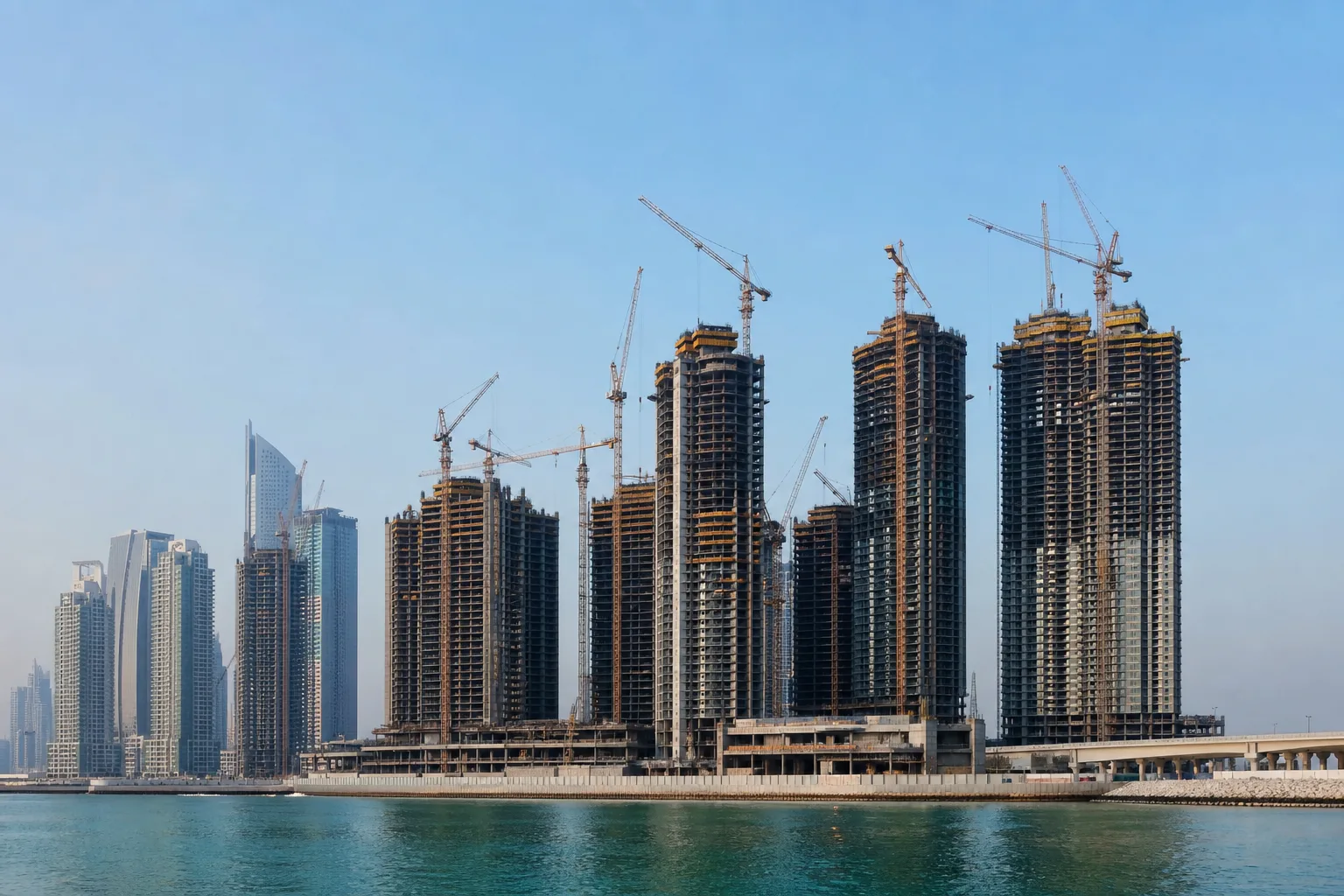
The appeal of off-plan lies in the staggered schedule and the entry price. On a project like The Archive by Imtiaz Developments in Dubailand Residence Complex, listed from AED 700,000 with delivery in September 2028, you spread the payments rather than committing all the capital upfront.
The milestones of an off-plan purchase
- Reservation: fixed booking (often AED 20,000 to 100,000) then a deposit of 5 to 20%.
- Signing the SPA and Oqood registration with the DLD.
- Payments according to the schedule (milestones) released from escrow.
- Handover after snagging and the completion certificate.
The flip side of off-plan is the delay and the execution risk: delivery can slip, and you only collect rent at handover. The choice of developer then becomes decisive — checking their delivery track record and financial strength conditions the success of the operation. For the full journey from reservation to handover, our guide to the off-plan buying process step by step walks through each escrow-protected stage.
Dubai Golden Visa through property: conditions and steps
Dubai's property Golden Visa is obtained from AED 2,000,000 of real estate investment and grants a renewable 10-year residence permit, according to the official UAE government portal. This threshold applies both to a single property and to a set of properties whose combined value reaches the amount, whether new or resale.
Featured
View projects: Six Senses Residences
From AED 10,259,700
Hand-picked new properties with end-to-end expert support.
View projects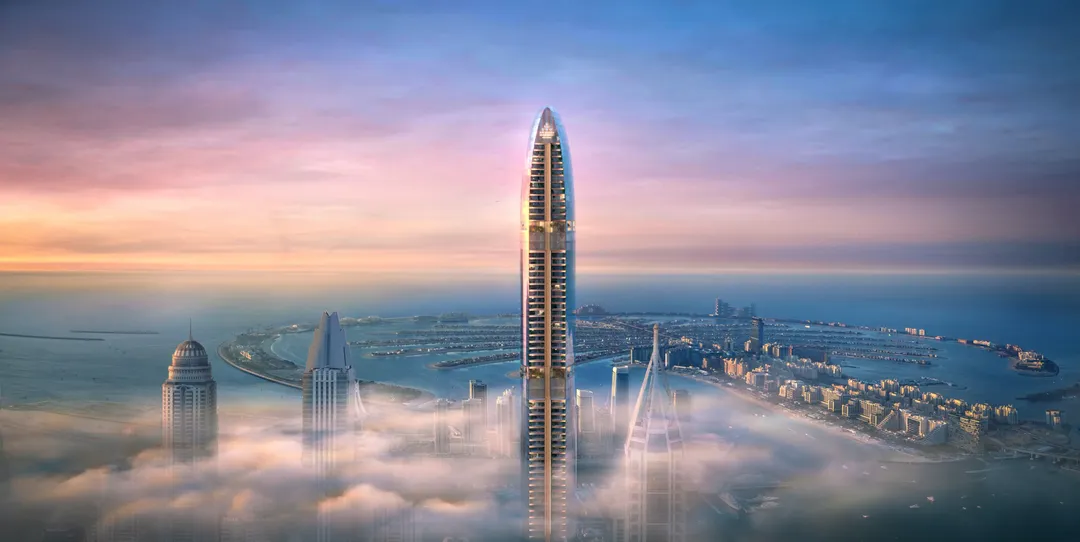
The visa isn't limited to its holder. It covers the spouse and children, with no age limit for the latter, and allows sponsoring domestic staff. That's what makes it a tool of family mobility as much as a resident status, with access to banking services, vehicle registration and local schooling. Our dedicated guide sets out the exact conditions and steps of the property Golden Visa, from the AED 2M threshold to the timelines and pitfalls.
On timing, processing is fast once the file is assembled: a few working days after submitting a complete file, but expect 2 to 4 weeks in total including the Emirates ID and the medical check, according to the dedicated service of the Dubai Land Department. The centrepiece of the file remains the title deed, the ownership title registered with the DLD.
A concrete example: Albero, by Emaar Properties in Dubai Creek Harbour, starts at AED 1.9M according to our catalogue — just below the threshold for an initial layout, but a larger surface or a second unit crosses the bar. This is the kind of trade-off we calibrate upstream so that the purchase serves both the yield and the securing of the visa. For the precise definition of the scheme, see our Golden Visa entry.
Financing a property purchase in Dubai: mortgage and down payment for non-residents
A non-resident in practice finances 50 to 75% of their purchase in Dubai, i.e. a down payment of 25 to 50%, depending on the bank and the profile, while the CBUAE caps mortgages for resident expatriates at 80% for a property up to AED 5M. The regulatory cap targets residents; the terms offered to non-residents are stricter and vary from one institution to another.
The regulatory scale is worth knowing before you negotiate. It sets the maximum loan-to-value (LTV) according to the nature and price of the property.
| Situation | Maximum financing (LTV) |
|---|---|
| Resident expatriate, property ≤ AED 5M | 80% |
| Resident expatriate, property > AED 5M | 70% |
| Second property | 60% |
| Off-plan purchase | 50% |
| Non-resident (in practice) | 50-75% |
Beyond the down payment, two items weigh on the financing plan. The DLD transfer fee (4% of the price) is not financeable and is paid in cash, as are agency fees on resale. Many buyers underestimate this initial cash outlay and find themselves short at signing — we set out the full picture in our guide to the non-resident mortgage and down payment.
For those who prefer to avoid the bank, developers offer payment plans staggered until delivery, or even beyond. This option, detailed in our page on payment plans, often replaces a mortgage on off-plan and avoids the constraints of a bank file. Bank leverage, for its part, comes into its own on a completed, already rented property.
Dubai's property market: trends and outlook
Dubai's market recorded AED 917 billion in cumulative property transactions in 2025 and keeps up the momentum: AED 252 billion in the first quarter of 2026, up 31% in value year on year, according to the Dubai Land Department. Volume is also rising, with 60,303 transactions over the quarter (+6%).
Foreign demand remains the engine. In the first quarter of 2026, foreign investment reached AED 148.35 billion (+26%), driven by 48,445 deals. Luxury real estate alone accounted for AED 87.71 billion, a sign that the high end concentrates a growing share of international capital.
The rental market follows the same trajectory. In 2025, 1.38 million rental contracts were registered for AED 126.4 billion, i.e. +17% in value year on year, with more than 513,000 new contracts (+10%). This depth of rental demand supports occupancy and reassures on resale liquidity.
Prices, for their part, no longer rise at the same pace everywhere. Across the 71 districts tracked by Bayut, the median 12-month change stands at +2.6%, with a median price of AED 1,883/sq ft. In other words, the market is shifting from a phase of broad catch-up to more selective growth, where the choice of district makes all the difference — a shift we read figure by figure in our guide to Dubai's real estate market trends and outlook.
Investing in Dubai by budget: what you buy at each price level
In Dubai, the entry ticket for a new-build investment starts around AED 500,000 and the median of the projects we list sits at AED 1.2M. Each budget tier opens up different districts and property types — from the compact apartment in a high-yield zone to the branded waterfront property, a progression we break down tier by tier in our guide to what each budget buys you in Dubai, fees and yields included.
Below one million dirhams, the target is affordable, high-yield districts. Coventry Curve 2, by GFS Developments in Dubai Industrial City (AED 1,331/sq ft, calculated gross yield 5.3% according to Bayut data of March 2026), starts at AED 500,000 according to our catalogue. This is the segment of studios and one-bedrooms designed for rental.
| Budget | What you target | Example district (Bayut price) |
|---|---|---|
| AED 500,000 – 1M | Studio / 1-bed, high yield | Dubai Industrial City — AED 1,331/sq ft (March 2026) |
| AED 1 – 2M | 1-2 beds, central district | Business Bay — AED 2,445/sq ft (February 2026) |
| AED 2 – 4M | Large apartment, premium address + Golden Visa | Downtown Dubai — AED 3,454/sq ft (March 2026) |
| AED 4M and up | Villa, penthouse, waterfront | Palm Jumeirah — AED 4,336/sq ft (March 2026) |
Between AED 1 and 2M, the range widens toward central districts. In Business Bay (AED 2,445/sq ft, February 2026, Bayut data), a project like Bayz 102 by Danube Properties starts at AED 1.6M according to our catalogue — a well-located one-bedroom, liquid on both resale and rental.
Above AED 2M, the budget crosses the Golden Visa threshold and unlocks prestige addresses. The amount doesn't tell the whole story: for the same surface, a property in Palm Jumeirah (AED 4,336/sq ft) costs more than triple one in Dubai Industrial City, but doesn't serve the same objective. What I advise: start from the objective — yield, residence, appreciation — then work up to the district, never the other way around.
Buy-to-sell strategies in Dubai: making a capital gain
Buying to resell in Dubai rests on a structural advantage: an individual pays neither capital gains tax nor rental income tax, according to the official UAE government portal. The entire capital gain stays in the investor's pocket, with only the 4% transfer fee weighing on each operation.
The most common strategy is to buy off-plan and resell before or at handover. Between reservation and completion, the property's value can rise at the pace of the district. The five-year figures speak for themselves in certain zones: Jumeirah Garden City posts +147.6% over 60 months and Dubai Industrial City +132.1%, according to Bayut data of March 2026. Past performance doesn't guarantee the next, but it maps the underlying dynamics.
Second lever: value added through renovation on a completed property. Buying in an established, undervalued district, renovating, then re-renting or reselling higher works well in addresses where demand is constant. The capital gain is then built at purchase, by paying below market price — our dedicated guide to buy-to-sell strategies and turning a profit works through the three profit levers net of costs, with a concrete example and the pitfalls of exiting too soon.
Third approach, long-term holding to capture appreciation and rent. In a district like Downtown Dubai (+51.9% over 60 months, Bayut data March 2026), the rent + appreciation pairing rewards patience. The concept of capital gains for individuals is detailed in our glossary. What I see as most profitable with our clients: targeting a district at the start of its cycle rather than chasing a stroke of genius on an isolated property.
Dubai's up-and-coming districts: where to buy before the rise
Dubai's up-and-coming districts can be spotted by their recent price dynamics: Bukadra posts +12.2% over 12 months, Dubai Silicon Oasis +5.7% and Dubai Industrial City +5.6%, all well above the market median (+2.6%), according to Bayut data of March 2026. These are zones where infrastructure and supply are rising faster than prices have yet adjusted.
Bukadra illustrates the profile of a district in full emergence. At AED 2,215/sq ft (March 2026, Bayut), its double-digit rise over a year reflects the arrival of new developments and the knock-on effect of the neighbouring Meydan zones. The calculated gross yield there remains modest (3%), a sign that buyers are primarily betting on appreciation.
At the opposite end of the spectrum, Dubai Silicon Oasis combines rise and yield. The district trades at AED 1,370/sq ft (March 2026, Bayut) for a calculated gross yield of 6.3% and a gain of +108.9% over 60 months. This dual quality — contained entry price and sustained rents — makes it a relevant entry point for a first investment.
The south of the city also concentrates long-term bets. Dubai South (AED 1,440/sq ft, +87% over 60 months according to Bayut, March 2026) benefits from Al Maktoum Airport and the spillover from Expo. A project like Calisi, by Zoya Developments, starts there at AED 700,000 according to our catalogue, for delivery in September 2028. We map each of these zones, prices and trajectory included, in our guide to Dubai's emerging districts to buy before prices rise.
Luxury real estate in Dubai: branded residences and exceptional villas
Dubai's luxury real estate accounted for AED 87.71 billion in transactions in the first quarter of 2026 (+26% year on year), according to the Dubai Land Department. This segment is pulling a growing share of the market and attracts the most mobile international capital.
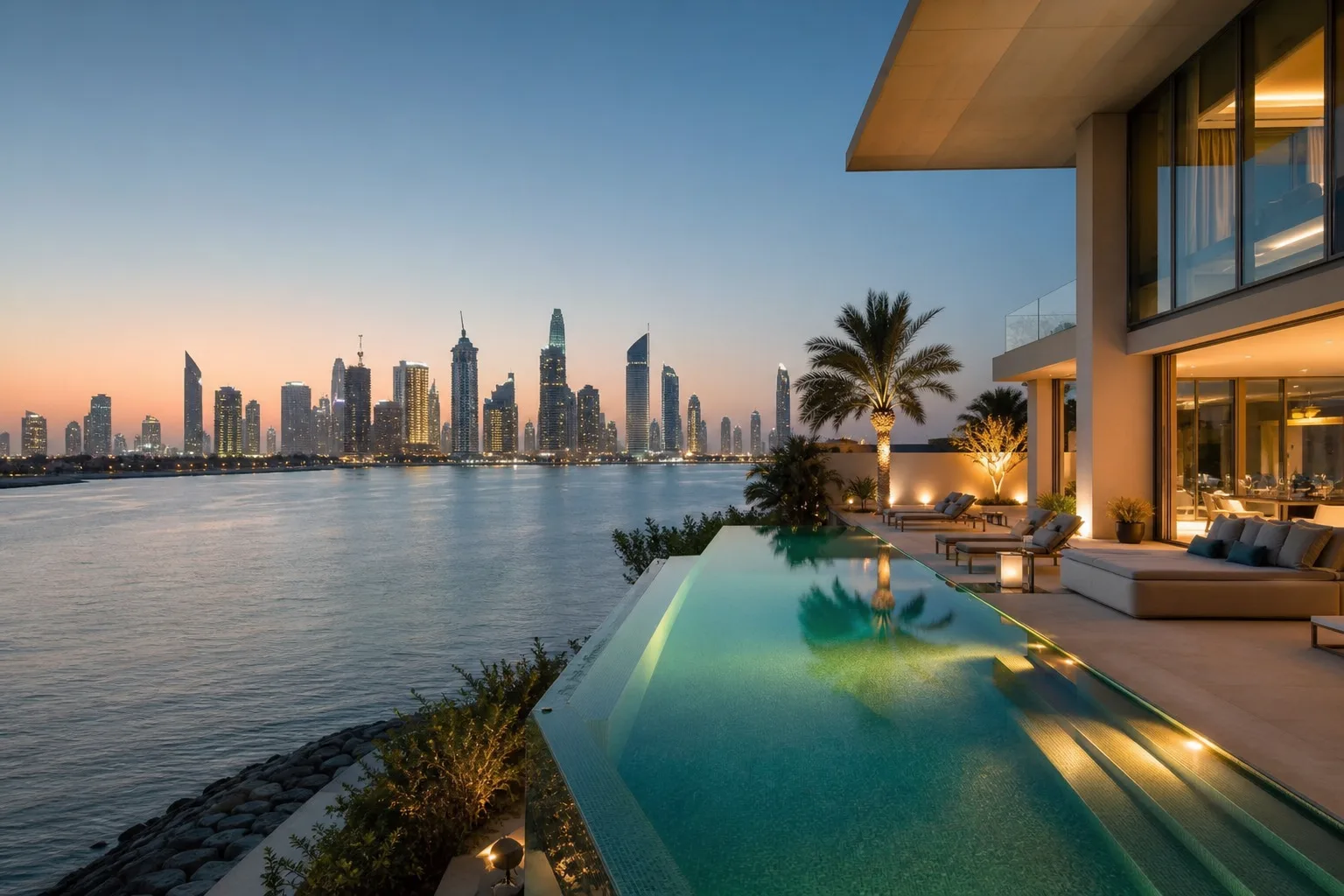
Prestige addresses show up in the price per square foot. Palm Jumeirah trades at AED 4,336/sq ft (March 2026, Bayut data), Dubai Harbour AED 4,295/sq ft and Jumeirah 2 AED 4,241/sq ft. In these markets, yield takes a back seat: Palm Jumeirah posts a calculated gross yield of 4.5%, with appreciation and use taking priority.
The big trend in the segment remains the branded residence — a building operated or signed by a luxury house or a carmaker. In Dubai Marina, Six Senses Residences, by Select Group, embodies this hospitality approach to living, with delivery planned for July 2028. In Meydan, the Mercedes-Benz Places development by Binghatti Developers pushes the branding logic all the way to the interior design.
Luxury also comes in the form of the exceptional villa. Keturah Reserve, by MAG Property Development in Al Quoz 2, targets clients seeking space and privacy, with delivery in March 2028. In this confidential market, access to the best units often comes through the network rather than the portals — and that's precisely where our local presence in Dubai opens doors closed to the general public. For the full picture of Dubai's branded residences and exceptional villas — price per square foot at premium addresses and the returns to expect — see our dedicated guide.
Choosing your developer in Dubai: reliability, guarantees and deliveries
Choosing a reliable developer in Dubai comes down to checking three things: the project's registration with a regulated escrow account, the delivery track record and financial strength. The funds paid are secured in an escrow account supervised by RERA and the Dubai Land Department, but this protection doesn't replace examining the track record.
The big names reassure through their volume and consistency. Emaar Properties, DAMAC Properties or Sobha Realty line up dozens of delivered developments and a recognised signature. Their price premium is paid in peace of mind on meeting deadlines and finish quality.
Mid-sized developers, for their part, often offer a better price/positioning ratio and aggressive payment plans. The cursor then shifts toward due diligence: a recent developer may be excellent, but the absence of a track record makes it essential to check the project's financing and the actual progress of the site.
A useful signal: the punctuality of past deliveries. A developer who has met their dates on previous developments inspires more confidence than a flattering brochure. We systematically cross-check the track record, the state of the site and financial health before presenting a development to our clients — our step-by-step method for checking a reliable property developer in Dubai walks through RERA registration, the escrow account and the delivery record, and you can browse all the listed players in our developer directory.
Buying in Dubai from abroad: the remote process
Buying in Dubai from abroad is perfectly possible without ever travelling, foreign freehold ownership having been open in the designated zones since 2002, according to the Dubai Land Department. A non-resident investor can reserve, sign and register a property remotely, provided they organise a few key steps upstream.
The central tool for a remote purchase is the power of attorney. It lets a trusted representative on the ground sign the documents, handle the DLD registration and collect the title deed in your name. Our page on power of attorney sets out its scope and limits.
Cross-border payment is prepared early. Opening a local bank account, useful for rents and charges, requires documentation and time. International transfers to the developer's escrow account must comply with anti-money-laundering procedures, which means justifying the origin of the funds — a point that sometimes stretches the timeline by several days.
The virtual viewing has made great strides, but it doesn't replace an eye on the ground. What I observe: the best remote deals are those where the client delegates to a local contact who inspects the property, checks progress and handles the after-sale. That's the heart of our support — from selection to handover, we are your eyes in Dubai, and we can target a district like Dubai Marina from the very first exchange. For a step-by-step walkthrough of the costs, the paperwork and the pitfalls, see our dedicated guide to buying property in Dubai from abroad, entirely remotely.
Dubai's established districts: where to buy in safe addresses
Dubai's established districts are those where the infrastructure is complete, rental demand is constant and prices have stabilised at a high level — as in Downtown Dubai (AED 3,454/sq ft, March 2026) and Business Bay (AED 2,445/sq ft, February 2026), according to Bayut data. Here you buy security and liquidity rather than the discount of the emerging.
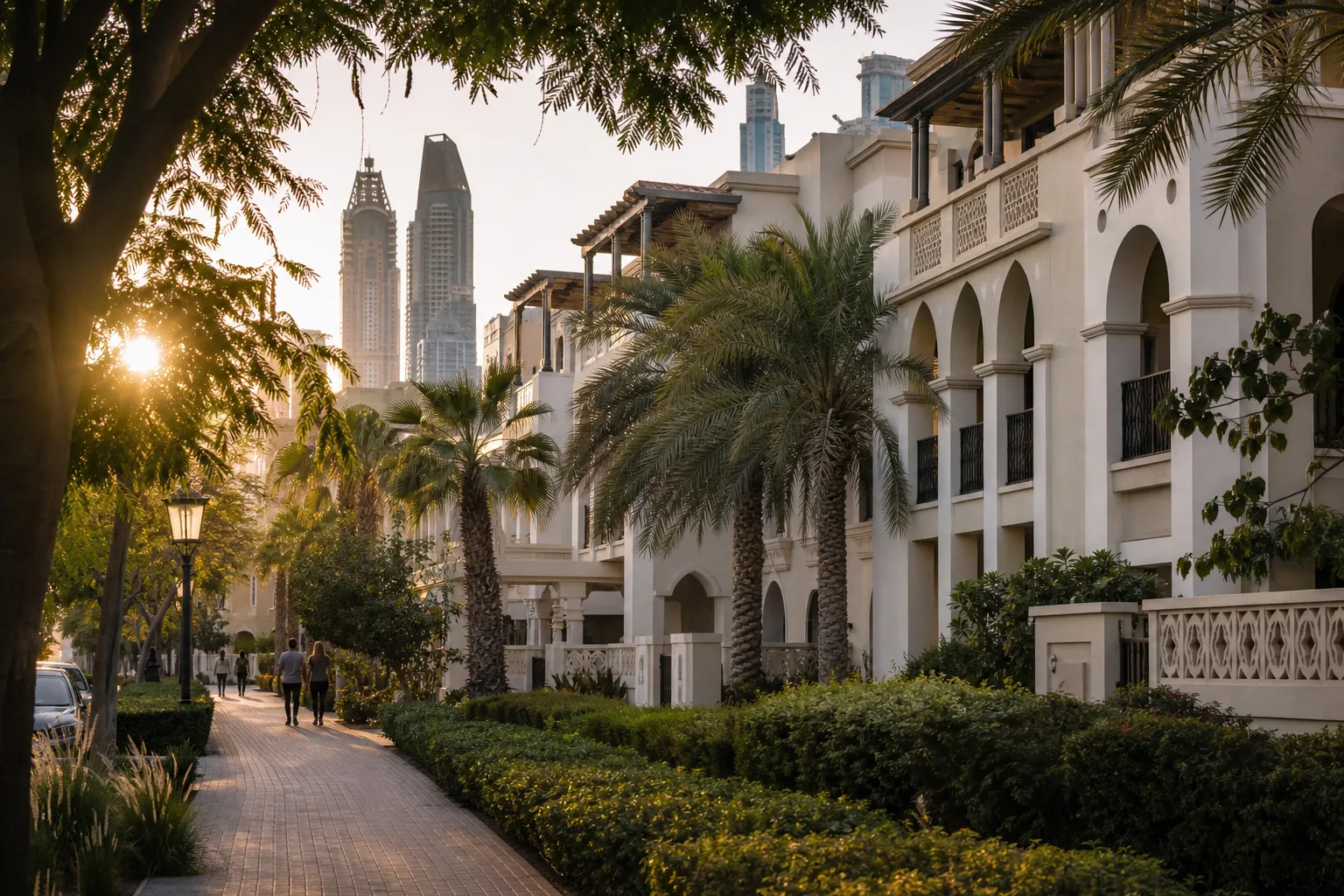
These addresses share a low-risk profile. Their 12-month change is measured — +1.7% in Downtown Dubai, +0.9% in Business Bay (Bayut) — but their market depth guarantees a quick resale and a steady rental flow. Downtown Dubai posts a calculated gross yield of 5.6%, Business Bay 5.8%, comfortable levels for central districts.
Dubai Marina completes this triangle of safe bets. At AED 2,376/sq ft (Bayut data) for a calculated gross yield of 5.8%, the district combines waterfront, residential towers and international rental demand that doesn't waver. It's a classic choice for a first liquid, easy-to-rent investment. To compare these addresses side by side — prices, yields and the pitfalls of each — see our detailed breakdown of what Dubai's prime districts really cost.
| Established district | Price (Bayut) | Calculated gross yield |
|---|---|---|
| Downtown Dubai | AED 3,454/sq ft (March 2026) | 5.6% |
| Business Bay | AED 2,445/sq ft (February 2026) | 5.8% |
| Dubai Marina | AED 2,376/sq ft | 5.8% |
| Palm Jumeirah | AED 4,336/sq ft (March 2026) | 4.5% |
In Business Bay, a project like Bayz by Danube, by Danube Properties, illustrates the district's offering. The principle stays the same at these addresses: you pay more per square foot, but you buy an asset that resells and rents without effort. For the prudent investor, it's the foundation of the portfolio.
In this guide
Articles in this guide
- Dubai Property Taxes: What Investors Actually Pay
- Rental Yield in Dubai: What to Really Expect
- Where to Invest in Dubai by Neighbourhood, by Objective
- Buying off-plan in Dubai: the step-by-step process
- Buying resale property in Dubai: the process for a completed home
- Financing a Dubai Property Purchase: Mortgages and Down Payment for Non-Residents
- Dubai Golden Visa Through Real Estate: Conditions and Steps
- Freehold in Dubai: Full Foreign Property Ownership
- Which Property Type to Invest in Dubai: Apartment, Villa or Townhouse
- Managing a Rental Property in Dubai: Property Management and Service Charges
- Mistakes to Avoid When Investing in Dubai Property
- Investing in Dubai vs Bali: Which Market Suits Your Profile
- Dubai Real Estate Market: Trends and Outlook
- Best Areas to Buy in Dubai: Prime Districts and What They Really Cost
- Dubai's up-and-coming districts: where to buy before prices rise
- Buy-to-Sell Strategies in Dubai: Turning a Profit
- Investing in Dubai by Budget: What Each Price Point Buys You
- Reliable Property Developer in Dubai: How to Check
- Buying Property in Dubai from Abroad: The Remote Process
- Luxury real estate in Dubai: branded residences and exceptional villas
About the author

Sofiane OULD
Founder & Chief Executive Officer
A visionary entrepreneur and recognized expert in Dubai's prestige real estate market, Sofiane began his career in Paris before joining major players in online real estate (SeLoger, MeilleursAgents, Airbnb). Based in Dubai since 2019, he quickly established himself as one of the city's top-performing brokers. Founder of Lucretia Immobilier, he now supports his clients with an approach combining integrity, innovation and excellence, thereby redefining the standards of luxury.