From budgeting to registering the title deed at the Dubai Land Department, here are the seven concrete steps to buying a completed property in Dubai with complete peace of mind.
On this page
- Buying a completed property in Dubai: the 7 steps of the resale process at a glance
- Step 1 — Set your budget and secure your financing before you search
- Step 2 — Find the property, verify the title and negotiate the offer
- Step 3 — Sign the sale contract (MOU / Form F) and pay the deposit
- How do you obtain the developer's NOC and prepare the transfer?
- Step 5 — Register the transfer at the DLD and obtain the title deed
- How much does a completed property earn once rented out?
Buying resale property in Dubai — that is, a home already completed and sold on by its owner — follows a seven-step path that ends with the title deed registered in your name, in exchange for a 4% transfer fee paid to the Dubai Land Department. Unlike off-plan, the property exists, can be viewed and can be rented out straight away: the yield kicks in the moment you get the keys.
The legal pivot of a resale is the sale contract signed between the two parties (Form F), followed by the developer's no-objection certificate, before the visit to the trustee office where the transfer becomes official. Each step has its own documents, timelines and costs — here they are in order, with the exact amounts to set aside.
Buying a completed property in Dubai: the 7 steps of the resale process at a glance
Buying a completed property in Dubai unfolds over seven steps, from setting your budget to the issuing of the title deed at the Dubai Land Department, with the decisive milestone remaining the transfer signing at the trustee office. Resale involves a finished property resold by its owner, whereas off-plan refers to a property bought from the developer while still on paper — a separate journey detailed in our Dubai investment guide.

The listed price is only part of the spend. Also to budget for: 4% DLD transfer fee, between AED 4,700 and 5,500 in fixed DLD fees, and agency fees of 2% of the price plus 5% VAT, borne by the buyer in a resale.
Here is what concretely separates the two journeys, before we get into the detail of the steps:
| Criterion | Resale (completed property) | Off-plan (on paper) |
|---|---|---|
| Sale contract | Form F (MOU) between the parties | SPA signed with the developer |
| Initial payment | Deposit ~10% held by the agent | Down payment 5 to 20% into escrow |
| Buyer's agency fee | 2% of the price + 5% VAT | Generally no commission |
| Document specific to the journey | Developer NOC mandatory | Escrow account protection (Law No. 8 of 2007) |
| Rental yield | Active from handover | After completion |
All foreigners can buy full ownership (freehold), in Dubai's designated areas, since 2002 according to the Dubai Land Department. The breakdown of permitted areas is covered in our Dubai investment guide.
Step 1 — Set your budget and secure your financing before you search
Calibrating the down payment is the very first decision, because a resident expat's mortgage is capped at 80% of the value for a property ≤ AED 5M, 70% above AED 5M and 60% for a second property, according to the CBUAE Rulebook. A non-resident, in practice, gets 50 to 75% of the price, meaning a down payment of 25 to 50% depending on the bank.

Transaction costs, on the other hand, can never be financed: set them aside in cash right now. Count on 4% DLD transfer fee, between AED 4,700 and 5,500 in fixed fees, and 2% agency fees plus 5% VAT — the complete line-by-line breakdown of the full purchase budget beyond the price is set out in our dedicated guide.
Then set a realistic entry ticket. The market's median price stands at AED 1,883/sq ft according to Bayut data (August 2026); choosing the area to match your objective is the subject of our guide on where to invest in Dubai.
Step 2 — Find the property, verify the title and negotiate the offer
The search goes through a RERA-registered agent, whose fee comes to 2% of the price plus 5% VAT on the buyer's side, and remains negotiable. This is the moment to pin down that commission in writing before making any offer.

A project in mind?
Talk to a Lucretia adviser
Tailored guidance, no obligation.
A resale calls for checks that an off-plan purchase does not:
- Validity of the current title deed and its match with the actual seller;
- No outstanding service charges attached to the property;
- The real condition of the completed property, to inspect before committing.
To put a price into perspective, measure it against the market: a median of AED 1,883/sq ft and a median rise of +2.6% over 12 months across 71 areas, according to Bayut data. Among completed-property areas, count on AED 2,445/sq ft in Business Bay (February 2026), AED 2,376/sq ft in Dubai Marina and AED 3,454/sq ft in Downtown Dubai (March 2026), again according to Bayut data. These benchmarks let you tell whether an offer is well or poorly positioned.
Step 3 — Sign the sale contract (MOU / Form F) and pay the deposit
The sale contract in a resale is the MOU, embodied by the DLD's Form F, which binds buyer and seller — the equivalent, here, of what the SPA is in off-plan. Signing it triggers the payment of a security deposit, usually 10% of the price, held by the agent.

This deposit should not be confused with the off-plan down payment, which ranges from 5 to 20% and is paid to the developer into an escrow account; that scenario is covered in our Dubai investment guide.
Before signing, lock down the conditions precedent:
- Actual securing of the loan and a refund clause in case of bank refusal;
- A clear split of fees between the parties;
- Timelines for completing the transfer.
Finally, keep in mind a holding cost, not a purchase cost: annual service charges, regulated via the Mollak system, weigh on returns. Their amount and impact are quantified in our tax guide.
How do you obtain the developer's NOC and prepare the transfer?
The NOC (No Objection Certificate), issued by the developer or the manager, confirms there are no unpaid service charges and is a precondition for any transfer — this is step 4, specific to resale. Without this document, the trustee office cannot register the sale.

Featured
View projects: Lunaya
From AED 6,798,750
Hand-picked new properties with end-to-end expert support.
View projects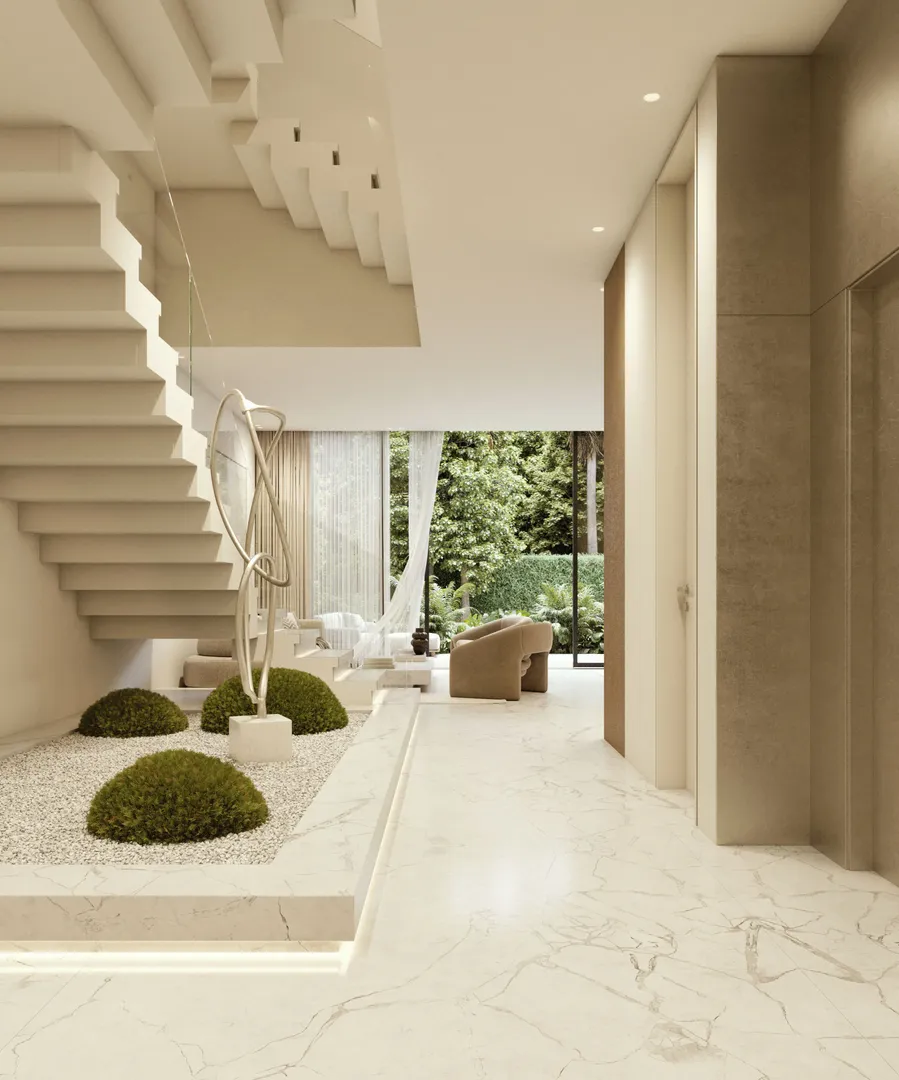
In parallel, assemble the complete file:
- Buyer's passport (and Emirates ID where applicable);
- Signed MOU (Form F);
- Manager's cheques for the price and the fees;
- Proof that outstanding charges have been settled.
If you are financing the purchase, the bank finalises its definitive offer letter here, within the LTV limits recalled in step 1. All that remains is to book the appointment at the trustee office, where the transfer will be registered; the centre's fees, of AED 4,000 to 4,200, are included in the fixed DLD fees.
In resale, the mistake I see most often is discovering unpaid service charges the day before the transfer. With my clients, we ask for the NOC and the statement of charges as soon as the Form F is signed — never after.
— Anastasiya OULD, Director of Relations & Corporate Affairs
Step 5 — Register the transfer at the DLD and obtain the title deed
The transfer day at the trustee office seals the sale: cheques handed to the seller, then payment of the 4% transfer fee to the Dubai Land Department and the fixed fees — title deed of around AED 580, plan fee of around AED 250 and trustee fee of AED 4,000 to 4,200, according to the DLD fees documented by Property Finder.

A new title deed is then issued in your name: full freehold ownership takes effect. The residential transaction itself carries no VAT: 0% on residential sales and rentals, the 5% being reserved for commercial.
If the property reaches AED 2,000,000, launch the Golden Visa application straight away. Processing generally takes a few working days once the file is complete, and 2 to 4 weeks in total with the Emirates ID and the medical exam, according to the Dubai Land Department.
How much does a completed property earn once rented out?
A completed property in Dubai is rentable from the moment you take possession and shows a gross yield of 5 to 8% depending on the area (2025), with 7 to 10% in affordable zones and around 5 to 6% in premium areas, according to Bayut. The full calculation method is set out in our rental yield guide. If a lower entry ticket and a lifestyle-driven bet also appeal to you, our comparison of investing in Dubai versus Bali weighs those trade-offs against Dubai's freehold security.

These gaps read area by area. In Arjan, the calculated gross yield reaches 7.1% for a price of AED 1,485/sq ft (March 2026); in Palm Jumeirah, it drops to 4.5% for AED 4,336/sq ft, according to Bayut data. The prestige of a location is paid for in yield points.
Then factor in the real recurring charges. Service charges range from AED 3 to 30/sq ft/year via Mollak: roughly 10 to 20 for an apartment, 20 to 50 and above for a luxury tower, 2 to 6 for a villa.
The holding framework remains favourable: 0% tax on rental income and on capital gains for individuals, according to the official UAE portal. The detailed tax treatment falls under the tax guide.
In this guide
Articles in this guide
This article is part of our guide
Dubai Property Investment Guide for Foreign Buyers
About the author

Anastasiya OULD
Director of Relations & Corporate Affairs
A specialist in the secondary market in Dubai, Anastasiya supports her clients in their search for exceptional properties. Thanks to her expertise and attention to detail, she identifies unique opportunities in sought-after neighborhoods such as Downtown Dubai, Business Bay and Palm Jumeirah. Passionate about art and interior design, she offers a tailor-made experience, ensuring each investor a property perfectly suited to their expectations in terms of prestige, location and profitability.