An individual pays no tax on rental income and none on capital gains in Dubai. We break down the only real costs: transfer fees, service charges, inheritance and the French tax side.
On this page
- What taxes does a property investor in Dubai actually pay?
- The real purchase costs: DLD, agency and fixed fees (worked example)
- From gross yield to net cash flow: which charges eat into profitability?
- Dubai property tax on the French side: the 1989 treaty and the tax credit
- Residence, financing and status: what changes the tax and practical picture
- Off-plan: escrow, deposit and tax at resale
- Transfer and inheritance: the trap to anticipate
Property tax in Dubai rests on a simple principle: an individual who owns a property in their own name pays 0% tax on rental income and 0% on capital gains at resale (official UAE government portal). No annual withholding, no property tax comparable to those in Europe.
This absence of taxation does not mean a purchase is free of any cost. One-off acquisition fees, recurring service charges and specific inheritance rules all shape the real return. We review them one by one, figures in hand — because these are precisely the items catalogued in our guide to the mistakes to avoid when investing in Dubai, where overlooked fees and misread yields cost the most.
What taxes does a property investor in Dubai actually pay?
Dubai has neither personal income tax nor a capital gains tax on real estate for an individual who owns in their own name. The 0% principle outlined above holds true item by item once you look at the detail — we break down exactly what an individual owner really pays on rental income in our dedicated guide.

VAT follows the same favourable logic for housing: 0% on residential sales and rentals, with the 5% rate reserved for commercial property (Federal Tax Authority). An apartment bought to let therefore never falls within the scope of VAT.
The 9% corporate tax on profits above AED 375,000, in force since June 2023, does not concern an individual holding their property in their own name (Federal Tax Authority). It targets legal entities, not direct ownership.
The real purchase costs: DLD, agency and fixed fees (worked example)
The main entry cost is the transfer fee from the Dubai Land Department: 4% of the purchase price, on top of which come fixed administrative fees.

These fixed DLD fees amount to roughly AED 4,700 to 5,500: the title deed around AED 580 (AED 40 for off-plan), plan fees about AED 250, and the trustee office AED 4,000 to 4,200 (source: Property Finder). In the secondary market, buyer-side agency fees come to 2% of the price + 5% VAT; for off-plan bought directly from the developer, there is generally no buyer-side commission (source: Property Finder).
Worked example: a one-bedroom of 800 sq ft in Dubailand Residence Complex
Take an apartment in the Dubailand Residence Complex district, listed at AED 1,277/sq ft according to Bayut data (March 2026). For 800 sq ft, the price comes to AED 1,021,600.
- DLD transfer fee (4%): AED 40,864 (Dubai Land Department)
- Agency fees (2% + 5% VAT): AED 21,454 (Property Finder)
- Fixed DLD fees: around AED 5,000 (Property Finder)
The entry budget excluding the price therefore reaches nearly AED 67,300, or roughly 6.6% of the price. It is this envelope, not an annual tax, that weighs at purchase.
From gross yield to net cash flow: which charges eat into profitability?
The yield shown by the portals is a gross yield, calculated as rent over price, before charges: it ranges from 7.1% in Arjan to 5.6% in Downtown Dubai and 4.5% on Palm Jumeirah (Bayut data, March 2026). These differences from one area to another are part of a deeper dynamic that we decode in our analysis of Dubai property market trends.


The main recurring charge is the annual service charge, regulated by RERA through the Mollak system: roughly AED 3 to 30/sq ft/year depending on the property (RERA / DLD Service Charge Index). Apartments sit around AED 10-20/sq ft/year, luxury towers AED 20-50+, and villas AED 2-6.
The premium versus affordable gap
On Palm Jumeirah, rent reaches AED 196/sq ft/year (Bayut, March 2026) but a luxury tower can carry AED 20 to 50+/sq ft/year in charges: the relative drag is heavy. In Arjan, rent of AED 106/sq ft/year (Bayut, March 2026) is subject to much lighter standard apartment charges, which better preserves the net return.
The detail of rental vacancy, management fees and the full net yield calculation appears in our complete guide to investing in Dubai.
Dubai property tax on the French side: the 1989 treaty and the tax credit
For a French tax resident, property income from Dubai is taxable in the UAE under the France-UAE tax treaty signed on 19 July 1989 (source: BOFiP). Double taxation is eliminated through a tax credit mechanism.

In practice, this tax credit equals the French tax: the tax due in France on this income is neutralised. The rents received in Dubai are nonetheless still taken into account to determine the effective rate of tax applied to the household's other income.
The distinction is clear: a French tax resident declares and applies the treaty; a UAE tax resident falls outside the scope of French tax on that same income. Lucretia clarifies this framework, then directs you towards a tailored wealth-planning study, because each family configuration calls for its own answer.
This tax foundation — 0% on rental income and capital gains, freehold ownership in designated zones — carries real weight the moment you compare Dubai with other lifestyle destinations. To measure what this framework changes against a market with a lower entry ticket but weaker ownership security, our analysis Dubai or Bali: which market for which profile sets the two models side by side.
Residence, financing and status: what changes the tax and practical picture
A real estate investment of at least AED 2,000,000 qualifies for the 10-year Golden Visa (official UAE portal). This is the threshold that turns a purchase into a residence project.

Featured
View projects: Keturah Reserve
From AED 3,871,000
Hand-picked new properties with end-to-end expert support.
View projects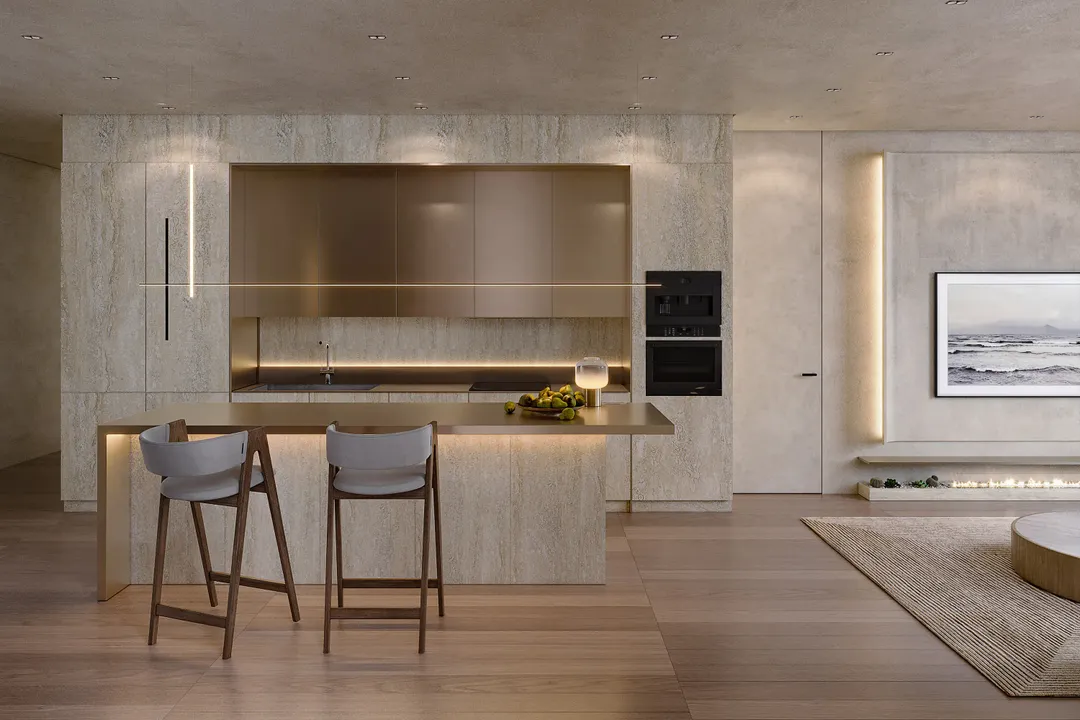
Processing is fast: a few working days once the file is complete, allowing 2 to 4 weeks in total including the Emirates ID and the medical check (Dubai Land Department). The exact conditions, the documents to gather and the pitfalls to avoid are set out in our dedicated guide to the Dubai Golden Visa through real estate.
Financing: residents and non-residents are not treated the same
The CBUAE caps lending to resident expatriates (CBUAE Rulebook):
| Situation | Maximum financing |
|---|---|
| Property ≤ AED 5M (resident) | 80% |
| Property > AED 5M (resident) | 70% |
| Second property | 60% |
| Off-plan purchase | 50% |
| Non-resident (in practice) | 50 to 75% (down payment 25 to 50%) |
Opening an account and the logistics of a purchase are covered in our complete guide to investing in Dubai.
Off-plan: escrow, deposit and tax at resale
With off-plan, funds are secured in a mandatory escrow account since Law No. 8 of 2007, under RERA/DLD supervision (Dubai Land Department). Your payments do not go directly to the developer.

A project in mind?
Talk to a Lucretia adviser
Tailored guidance, no obligation.
The reservation deposit ranges from 5 to 20% of the price, often 10 to 20%, sometimes preceded by a fixed booking fee of around AED 20,000 to 100,000 before signing the SPA (market sources SBA/Grosvenor).
Buying new reduces the entry fees detailed above: the title deed stays minimal and the buyer escapes the secondary-market agency commission. At resale, the capital gain remains taxed at 0% for an individual (official UAE portal) — though to turn this exemption into a real gain, you still have to think net of fees: our buy-and-sell strategies for realising a capital gain detail the levers and the pitfalls that wipe out a gain made too soon.
A project such as The Archive in Dubailand Residence Complex, from AED 700,000 according to our catalogue, illustrates this new-build entry ticket.
Transfer and inheritance: the trap to anticipate
By default, Sharia law may apply to inheritance in Dubai, which upends the succession rules expected in Europe (DIFC Courts). This is the point most often overlooked.

The remedy exists and it is simple: a will registered with the DIFC Wills or the Dubai courts secures the transfer for non-Muslims, freely designating the heirs of the property.
With my clients, I almost always see the same thing: they optimise the yield down to the last dirham, and forget the will. Yet it is the first document I have put in place as soon as the property goes beyond a mere investment.
— Benoit CLAUDEL, Director of Strategy & Operations
Locally, no inheritance tax applies to the transfer for individuals. French inheritance tax, however, may apply depending on the residence of the deceased and the heirs. Anticipating the ownership structure — residence, income or transfer — is decided upfront, not at resale.
In this guide
Articles in this guide
This article is part of our guide
Dubai Property Investment Guide for Foreign Buyers
About the author

Benoit CLAUDEL
Director of Strategy & Operations
With over 18 years of experience in real estate and wealth management, Benoît has developed recognized expertise in advising private investors, business executives and family offices. After starting out in a real estate agency and working within one of the most reputable wealth management firms in Paris, he then joined LCL as Head of Private Banking for Île-de-France, advising high-income clients on their real estate strategies. An entrepreneur, he founded and ran his own wealth management firm for 7 years, structuring investment and wealth optimization solutions. Today at Lucretia, Benoît oversees operational strategy, sales performance and advisor training. He works on high-value-added cases, particularly investments via French holding companies, legal structuring and wealth taxation.