In September 2026, law firm A&O Shearman published a series of guides on the reforms affecting every stage of an Abu Dhabi property transaction. For off-plan buyers, three protections stand out: the escrow account, a cancellation scale set by regulation and tighter rules on service charges.
On this page
Abu Dhabi off-plan property law has been overhauled, and in September 2026 the international law firm A&O Shearman, formed in 2024 from the merger of Allen & Overy and Shearman & Sterling, published a series of practical guides on the changes. The firm reviews the reforms adopted over the past two years: protection of buyers' funds, delivery of off-plan projects, cancellations, jointly owned property governance, professional conduct and rent setting.
At the heart of the system sit the Abu Dhabi Real Estate Centre (ADREC), the emirate's regulator, and the Department of Municipalities and Transport (DMT). On 30 March 2026, the DMT announced four administrative decisions implementing Law No. 3 of 2015, as amended by Law No. 2 of 2025. A&O Shearman stresses one key point: these rules apply throughout the emirate except in the Abu Dhabi Global Market (ADGM), which has its own legal framework.
Key takeaways
- According to the Abu Dhabi Real Estate Centre's report for the first half of 2026, Abu Dhabi recorded 25,714 property transactions worth AED 117 billion, up 112% in value and 61.7% in volume on the first half of 2025.
- According to ADREC, off-plan sales accounted for 89% of the value of residential sales and 82% of residential transactions in Abu Dhabi in the first half of 2026.
- Administrative Decision No. 165 of 2025 sets a scale based on construction progress when a defaulting off-plan buyer's contract is cancelled: full refund if the project has not started for reasons beyond the developer's control, 10% of the price retained up to 10% completion, 40% beyond 60%.
- Since Administrative Decisions No. 25 and 26 of 2025, any service charge billed in Abu Dhabi without ADREC approval is unlawful and cannot be claimed from the owner.
- In Abu Dhabi, an owners' committee must be formed once 30% of the units in a development are registered to multiple owners. It has five to nine elected members, and the developer cannot sit on it.
Escrow now protects the off-plan buyer's money from start to finish
In Abu Dhabi, money paid by an off-plan buyer goes into an escrow account dedicated to the project. The developer can only draw on it under conditions set by ADREC. Before the reform, no withdrawal was possible until construction reached 20%, certified by an approved engineer. Administrative Decision No. 24 of 2025 now allows earlier withdrawals, but under strict control.
In return, the developer must provide a bank guarantee issued by a local bank approved by ADREC. The regulator can call it on demand. It is only released on full completion of the project, or from 60% completion if the escrow balance is enough to fund the rest of the works. Together, the escrow and the guarantee must therefore always cover the cost of delivery.
A regulated cancellation scale replaces case-by-case negotiation
Before 2025, the law already allowed an off-plan contract to be cancelled for serious breach. But it set neither compensation nor refund deadlines, which left room for disputes. Decision No. 165 of 2025 establishes a scale tied to construction progress, assessed by ADREC or its consultants. Beyond 60% of the price paid, ADREC may set the amount case by case.
- The escrow agent refunds both parties within 15 working days.
- Any sum collected by the developer outside the escrow must be returned in full to the buyer within 30 days of ADREC's notification. The developer cannot withdraw anything from escrow until this refund is made.
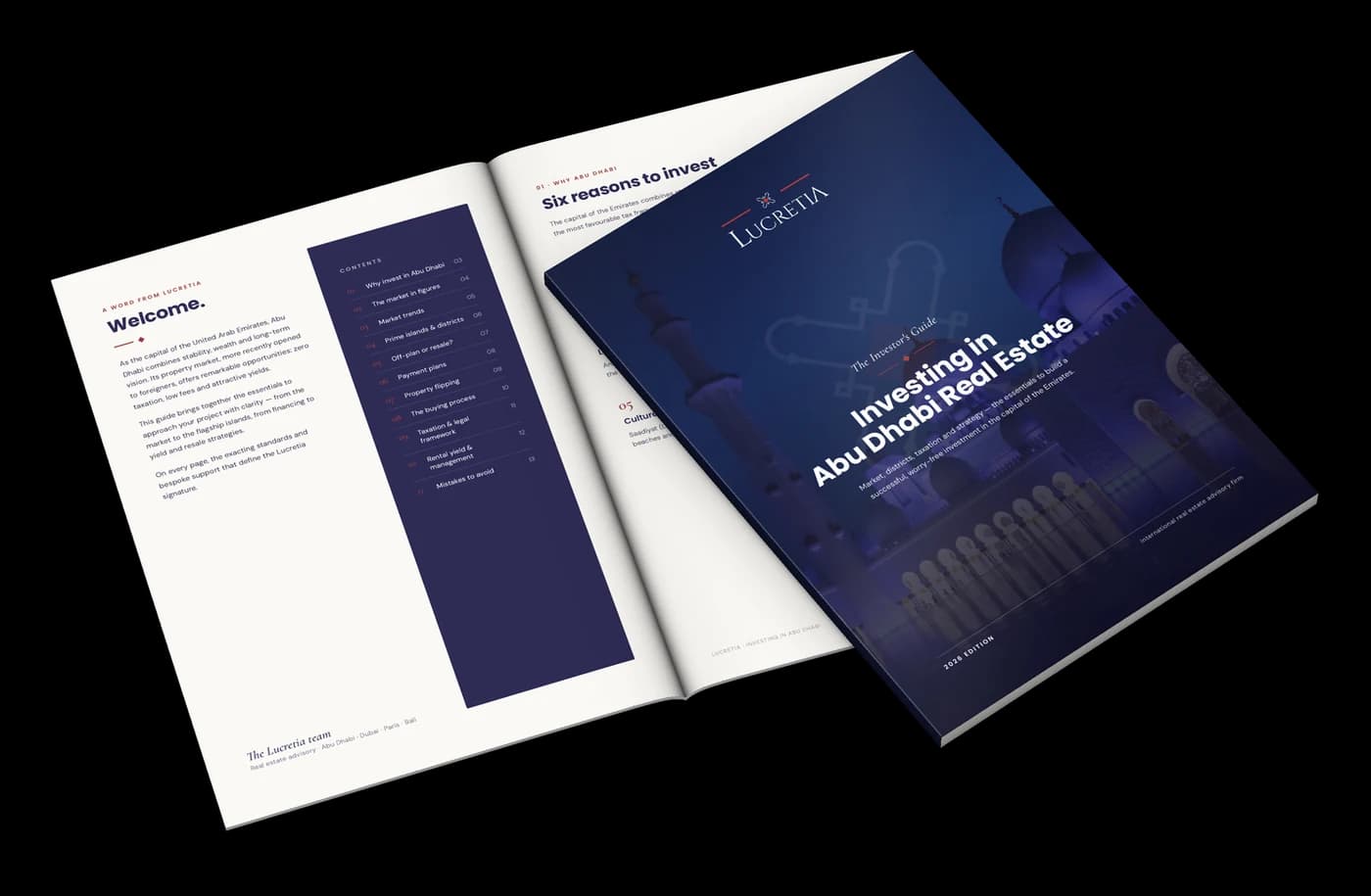
Free guide, delivered on WhatsApp
Get our investment guide
Taxation, visas, financing, buying steps: 14 pages sent to your WhatsApp within minutes.
Service charges approved by ADREC, and a separate regime in ADGM
Once the building is handed over, Decisions No. 25 and 26 of 2025 give a regulatory framework to practices that until now were governed by contract alone. ADREC approves annual budgets, management companies and service charges. Unpaid charges are secured by a lien on the unit: they follow the property to the new owner. They must therefore be checked before any resale purchase.
All these rules stop at the boundaries of ADGM, whose jurisdiction covers Al Maryah Island and Al Reem Island. On these two islands, sales fall under ADGM's own framework. The same investor may therefore face two regimes depending on which side of the water they buy. Our guide Investing in Abu Dhabi presents the emirate's districts and their ownership rules.
What it means for investors
For an investor, these reforms mainly reduce execution risk, the heaviest risk in buying off-plan. You know who holds the money and when the developer can use it. In case of default, you know the cost of exiting. In our view, this is a real gain in clarity: the cost of a cancellation can be calculated in advance rather than negotiated in court. We systematically check the escrow account number and the project's certified progress before any reservation.

Whether reselling or letting, service charge regulation matters too. ADREC-approved charges make net yield easier to forecast. The lien on arrears, however, calls for rigorous checks before any resale purchase. For projects on Al Reem Island, we review each contract against the ADGM framework, which differs from the rest of the emirate.
Lucretia helps you choose between these regimes, select developers and secure every step, from reservation to key handover. To place these rules within an overall strategy, see our page on investing in Abu Dhabi real estate.
Source: mondaq.com — Sept. 2026
This article is part of our guide
Abu Dhabi Property Investment Guide: Buy, Let and Resell with Confidence
About the author

Sofiane OULD
Founder & Chief Executive Officer
A visionary entrepreneur and recognized expert in Dubai's prestige real estate market, Sofiane began his career in Paris before joining major players in online real estate (SeLoger, MeilleursAgents, Airbnb). Based in Dubai since 2019, he quickly established himself as one of the city's top-performing brokers. Founder of Lucretia Immobilier, he now supports his clients with an approach combining integrity, innovation and excellence, thereby redefining the standards of luxury.