No tax on rental income or capital gains for individuals, a 2% transfer fee on purchase: here is what an Abu Dhabi property investment really costs, with district-by-district calculations.
On this page
- Abu Dhabi property tax: what does an investor actually pay?
- Worked example: AED 1.5M invested in Al Rahah, from purchase to rent received
- How many months of rent does it take to recover the 2% fee, by district?
- Tax-free capital gains: why the 2% entry cost still matters on resale
- The framework that makes this tax regime accessible: designated zones, DARI and the Golden Visa
- The traps behind the idea of a "cost-free" investment
For an individual, Abu Dhabi property tax comes down to a single quantified charge: a transfer fee of 2% of the purchase price, paid through DARI. Personal income tax stands at 0%, which exempts both rental income and capital gains, according to the Official Portal of the UAE Government.
Under this regime, you know the tax cost of a purchase down to the dirham before you sign. Yet I see many clients stop at the "zero tax" slogan without weighing what the 2% does to their yield or to a quick resale, or what their country of residence may claim. At Lucretia, we quantify the real advantage and fit it into your wider wealth strategy.
Abu Dhabi property tax: what does an investor actually pay?
It all depends on who is buying. An individual pays only the transfer fee, collected by ADREC (Abu Dhabi Real Estate Centre) through its DARI platform when the property is registered. A company, by contrast, falls under UAE Corporate Tax.
This 0% applies only to individuals, throughout ownership and on resale: we explain what it covers in our guide to 0% taxation of rental income and capital gains. Buying through a company puts you in a separate regime, which cannot be inferred from the rules for individuals. Its depreciation rules are set out in the "What has changed" box above.
Worked example: AED 1.5M invested in Al Rahah, from purchase to rent received
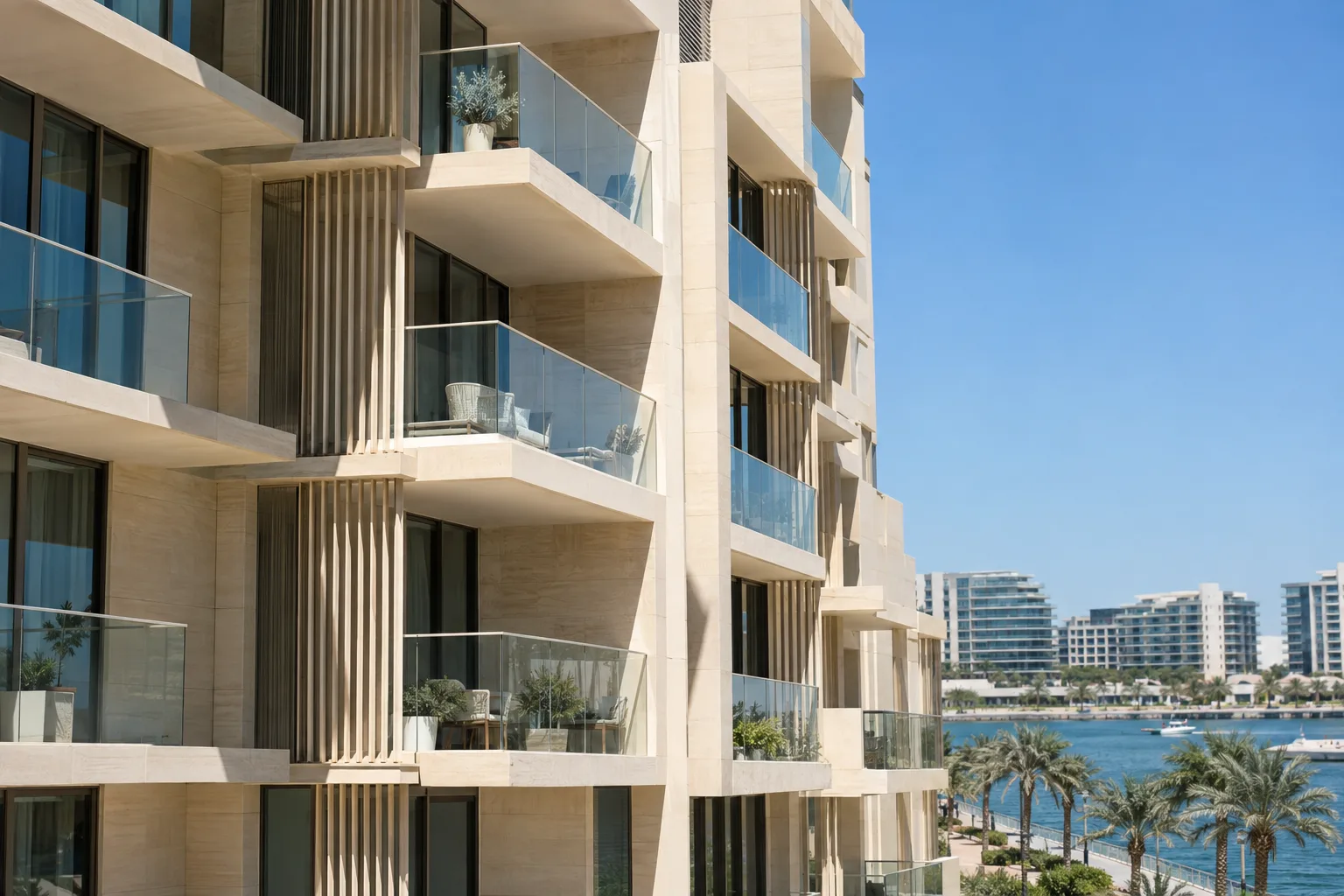
For an AED 1.5M purchase in Al Rahah, you pay AED 30,000 in transfer fees, then collect around AED 86,000 in gross annual rent with no tax withheld. The AED 1.5M figure is the median entry price of the projects we list in Abu Dhabi, which range from AED 500,000 to AED 2M (17 projects with a published price).
- Transfer fee: 2% of AED 1,500,000, i.e. AED 30,000, bringing the total outlay to AED 1,530,000 (rate published by DARI).
- Floor area: at AED 1,691/sq ft according to Bayut data (February 2026), this budget buys around 887 sq ft.
- Rent: 887 sq ft at AED 97/sq ft/year according to Bayut data (February 2026), i.e. around AED 86,000 gross per year.
- Calculated gross yield: 5.7%, in line with the market median (5.7% across 8 districts, according to Bayut data), before service charges and vacancy.
No tax eats into that AED 86,000. The AED 30,000 in fees represents about four months of gross rent: that is the real tax cost of the deal.
In new-build, Baia, a Reportage Properties project due for handover in June 2029, gives a sense of what the district offers. The calculation method is explained in our guide to rental yields in Abu Dhabi.
How many months of rent does it take to recover the 2% fee, by district?
Depending on the district, it takes between 3.5 and 10 months of gross rent to cover the 2% transfer fee, based on gross yields calculated from Bayut data (March and April 2026). The calculation fits on one line: divide 2% by the calculated gross yield, then multiply by 12.
A project in mind?
Talk to a Lucretia adviser
Tailored guidance, no obligation.
| District | Price (AED/sq ft) | Calculated gross yield | Months of gross rent to cover the 2% | Bayut data month |
|---|---|---|---|---|
| Reem Island | 1,497 | 6.8% | ≈ 3.5 | March 2026 |
| Al Maryah Island | 2,043 | 6.8% | ≈ 3.5 | March 2026 |
| Yas Island | 1,922 | 5.8% | ≈ 4.1 | March 2026 |
| Al Bahyah | 858 | 5.2% | ≈ 4.6 | April 2026 |
| Al Saadiyat Island | 2,714 | 4.3% | ≈ 5.6 | March 2026 |
| Ghantout | 1,546 | 3.9% | ≈ 6.2 | March 2026 |
| Al Jurf Gardens | 1,603 | 2.4% | 10 | March 2026 |
The higher the yield, the faster the entry costs are recovered. In Al Jurf Gardens it takes ten months, because rent of AED 39/sq ft/year remains low relative to price (according to Bayut data, March 2026).
Across the 7 districts in the table, the calculated gross yield ranges from 2.4% to 6.8%. Our guide Where to invest in Abu Dhabi compares these areas from a capital growth perspective.
Tax-free capital gains: why the 2% entry cost still matters on resale
On resale, an individual keeps the full capital gain, taxed at 0% according to the official UAE portal, but that gain must first offset the 2% paid on purchase. Over a short horizon, this threshold decides whether the deal makes money.
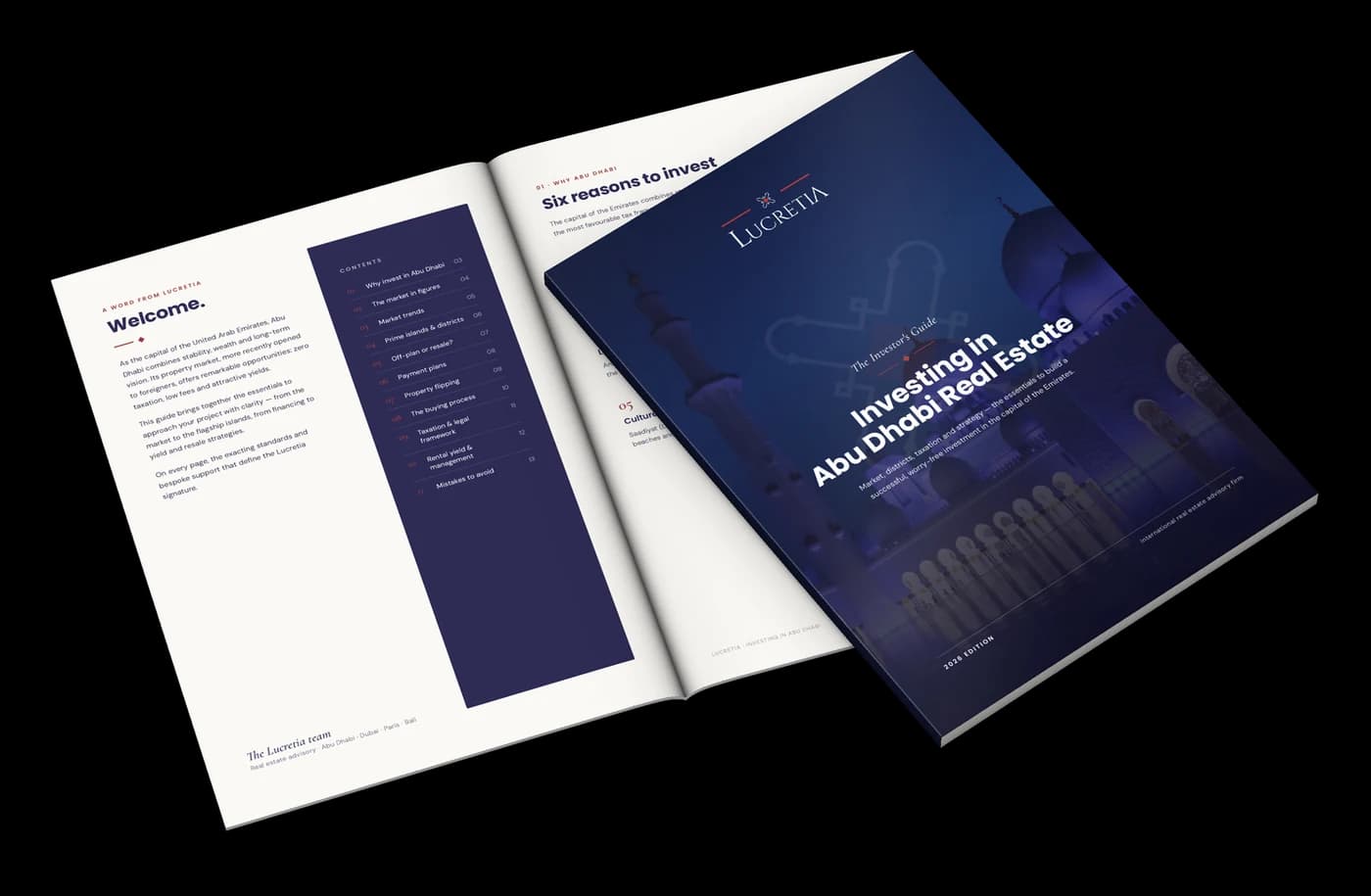
Free guide, delivered on WhatsApp
Get our investment guide
Taxation, visas, financing, buying steps: 14 pages sent to your WhatsApp within minutes.
Take Fahid Island: AED 3,844/sq ft in March 2026 and +1.8% over 12 months, according to Bayut data. A buyer who sold after one year would not even have recouped the transfer fee.
Al Bahyah shows another limit: +44.4% over 12 months, but −8.6% over 36 months (according to Bayut data, April 2026). An untaxed gain is not a guaranteed gain: it depends on when you buy and when you sell.
The practical steps of a sale, from valuation to transfer, are covered in our guide to selling a property in Abu Dhabi.
The framework that makes this tax regime accessible: designated zones, DARI and the Golden Visa
The 0% only benefits those who can buy: in Abu Dhabi, foreigners can own property in designated investment zones such as Al Reem, Yas and Saadiyat, according to DARI. The districts cited in this guide are concentrated in these zones.
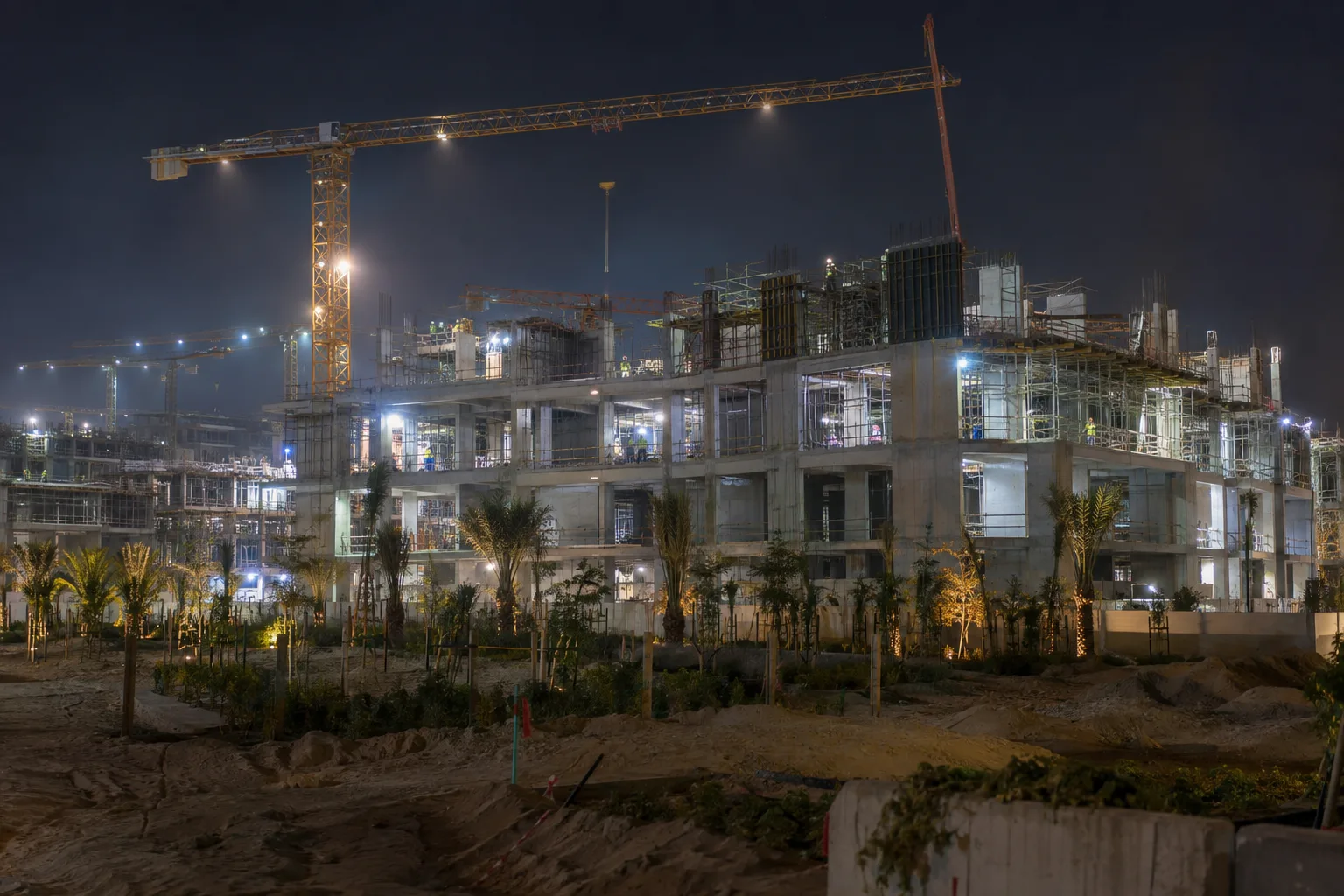
ADREC, through DARI, is the buyer's single point of contact: it collects the transfer fee and registers the property. The same 2% rate applies on the developer side when registering a land sale contract, according to ADREC. The transfer steps are described in our guide to the property buying process in Abu Dhabi.
Residency comes on top of the tax advantage: the 10-year Golden Visa is available from AED 2,000,000 invested in property. At that threshold, the transfer fee reaches AED 40,000.
The Al Ghadeer Parks project, developed by Aldar Properties in Al Layyan, starts at AED 2M, right at the threshold. Visa conditions are detailed in our guide Abu Dhabi property Golden Visa, and the Invest in Abu Dhabi page offers a market overview.
The traps behind the idea of a "cost-free" investment
The main trap is mistaking the UAE's 0% for no costs at all: the regime exempts your gains in the UAE, but not necessarily elsewhere, and it only applies to individuals.
- Your tax residence: your country of residence may tax rent and capital gains earned in Abu Dhabi under its own rules. This is handled case by case with an adviser.
- Gross is not net: yields calculated from Bayut data take no account of service charges or vacancy (see gross vs net yield). Recurring costs are covered in our guide to property management in Abu Dhabi.
- Leaving the 2% out of the budget: it comes on top of the price and is not automatically included in the developer's payment plan (see our guide to transfer fees and acquisition costs). Factor it in as soon as you plan the financing of your Abu Dhabi purchase.
- Buying through a company: Corporate Tax applies, with specific depreciation rules for investment property, detailed in the "What has changed" box at the top of this guide (source: Arabian Business).
- Dated figures: the Bayut data used here runs from February to April 2026. Check the rules in force on the official UAE portal and on DARI before signing.
On holding-company files, I find that the choice of structure often weighs more than the price per square foot. That is why we settle it before reservation, never after.
In this guide
Articles in this guide
This article is part of our guide
Abu Dhabi Property Investment Guide: Buy, Let and Resell with Confidence
About the author

Benoit CLAUDEL
Director of Strategy & Operations
With over 18 years of experience in real estate and wealth management, Benoît has developed recognized expertise in advising private investors, business executives and family offices. After starting out in a real estate agency and working within one of the most reputable wealth management firms in Paris, he then joined LCL as Head of Private Banking for Île-de-France, advising high-income clients on their real estate strategies. An entrepreneur, he founded and ran his own wealth management firm for 7 years, structuring investment and wealth optimization solutions. Today at Lucretia, Benoît oversees operational strategy, sales performance and advisor training. He works on high-value-added cases, particularly investments via French holding companies, legal structuring and wealth taxation.