In a post published on 16 August 2026 on our Instagram account, Sofiane, an advisor at Lucretia, explains why, in Dubai, the buying strategy matters more than the property itself in a buy-to-sell operation.
On this page
In a post published on 16 August 2026 on our Instagram account (@lucretia_immobilier), Sofiane, an advisor at Lucretia, answers a question raised by a follower: what strategy should you adopt to succeed in a buy-to-sell operation in Dubai? His answer boils down to one strong idea: in Dubai, the real difference isn't made on the property you buy, but on the way you buy it. The choice of neighbourhood, the moment you enter a project and the leverage — through the developer first, then through the bank — often weigh more heavily on the final result than the quality of the property alone.
@lucretia_immobilier · 16 August 2026
In Dubai, the real difference isn't made on the property you buy, but on the way you buy it. Bank leverage, buy-to-sell strategy, timing your entry into a project… that's what separates a good investment from a truly profitable operation. In this video, Sofiane shares how he supports his clients on buy-to-sell operations, to position themselves intelligently, without spreading themselves too thin. Do you have a buy-to-sell project in Dubai? DM Sofiane, he'll get back to you. #dubairealestate #propertyinvestment #dubai #realestatestrategy #lucretiaimmobilier
The essentials
- In a post dated 16 August 2026, Sofiane, an advisor at Lucretia, breaks down his approach to supporting buy-to-sell operations in Dubai.
- He steers buyers towards developing neighbourhoods rather than mature city centres, notably southern Dubai, the Palm Jebel Ali area and Al Jurf in Abu Dhabi.
- He highlights the leverage offered by solid developers through staggered payments: according to his example, a €300,000 contribution can carry a €1 million acquisition over one to two years.
- According to the banking framework described in the post, a non-resident (France, Luxembourg, Switzerland) can borrow in Dubai up to 65% of the property's value as assessed at handover.
- The loan can be taken out over a maximum term of around 25 years, up to the borrower's age of 65.
Location and entry timing above all
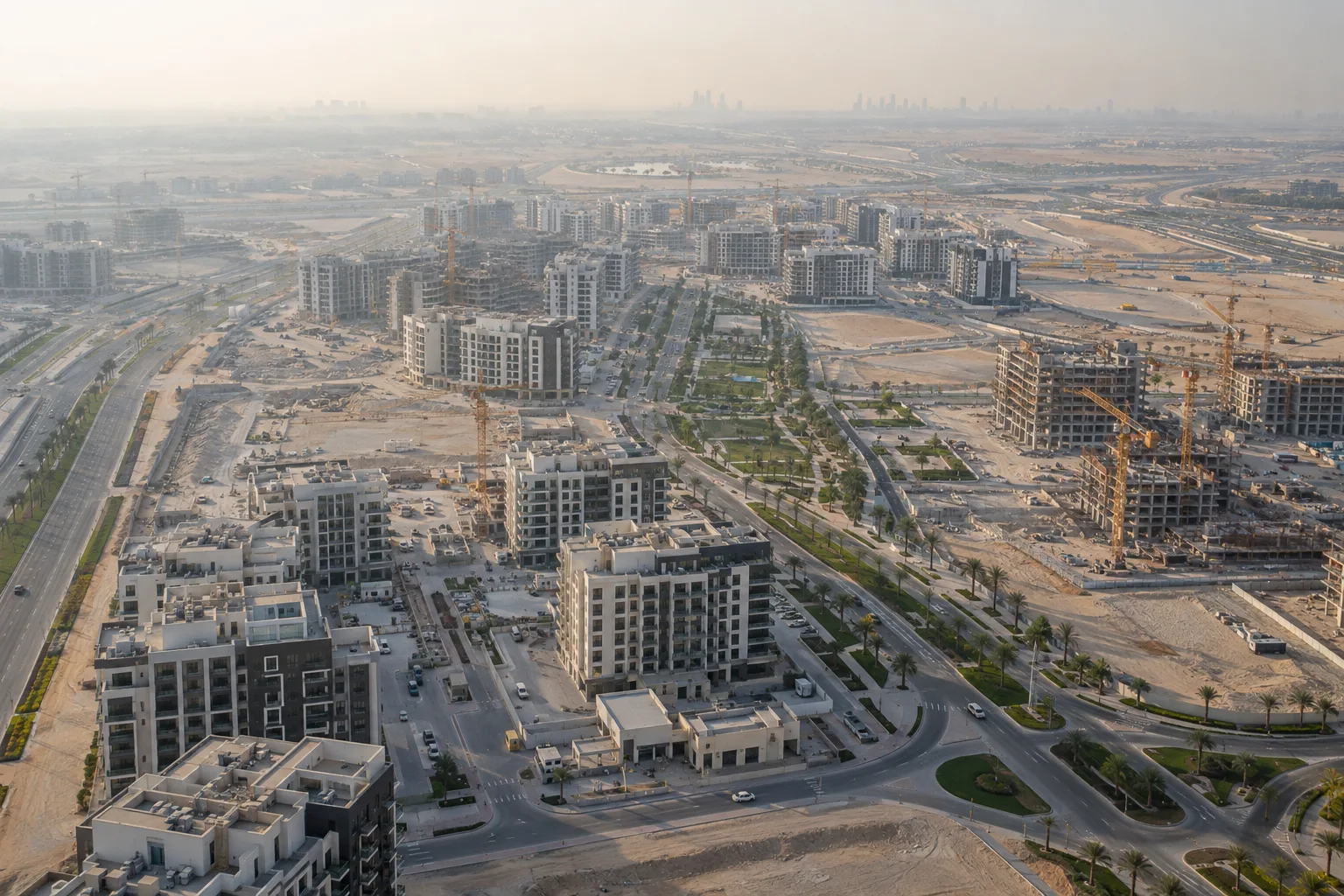
The central message of the post: in a buy-to-sell operation, performance is decided at entry, not at exit. Sofiane recommends favouring developing neighbourhoods, where the price per square metre remains low, over already-mature city centres — except in the specific case of a buy-renovate-sell, where the centre still makes sense. He specifically cites southern Dubai, the Palm Jebel Ali area and Al Jurf in Abu Dhabi as places where, in his view, the room for growth is most attractive.
This reasoning ties into a question every investor has to settle upfront: which property, in which neighbourhood, for which strategy. We cover it in detail in our guide on which type of property to favour for investing in Dubai — apartment, villa or townhouse. The logic of an off-plan buy-to-sell differs markedly from reselling a property that's already been delivered, whose process we describe in our guide on buying on the secondary market in Dubai.
Free guide, delivered on WhatsApp
Get our investment guide
Taxation, visas, financing, buying steps: 14 pages sent to your WhatsApp within minutes.

Two levers: the developer, then the bank
The first lever comes from the developer. By buying off-plan from a solvent player who has already delivered and who doesn't need the buyer to fund their construction site, the investor spreads their payment over time without tying up all their capital. The example given in the post: with €300,000, you can position yourself on a €1 million property paid over one to two years. If the value rises during the construction period, the return is calculated on the capital actually committed, not on the total price — that's the principle of leverage.
The second lever is banking, and it's the one most buyers underestimate. Even while residing in France, Luxembourg or Switzerland, it's possible to borrow in Dubai. At handover, the bank appraises the property and can finance up to 65% of its value — a level consistent with the loan cap generally seen for non-residents on the Emirati market. An investor who doesn't want to sell can thus hold onto their property, draw on credit and, in some cases, generate positive cash flow.
What the bank lends, and on what terms
The post spells out the parameters of post-handover financing: a term of up to around 25 years, capped at age 65 at maturity, and a loan calculated on the appraised value at handover. If a property bought for €1 million is worth €1.2 million at delivery, it's that latter value that serves as the basis for the loan. That's what makes it possible, with the rent levels seen in Dubai, to consider covering the monthly payment and keeping a net income.
To the question "and what if I can't resell?", Sofiane responds with method: eighteen years of experience, upstream selection and the existence of that banking safety net which, if needed, turns a resale operation into a rental investment. That's precisely the trade-off we help frame upfront.
What this changes for the investor
What we take away from this post: in buy-to-sell in Dubai, the essentials are decided before signing. The location–entry timing pairing, the developer's strength and the payment schedule determine your room to manoeuvre far more than the property itself. At Lucretia, we therefore place the upstream work — neighbourhood analysis, the developer's delivery track record, the structure of the payment schedule — at the heart of every Dubai investment file.
Leverage is an accelerator, but it works both ways: it amplifies the gain when the market rises and it increases exposure if the resale timeline gets tight. We promise no set return and no capital gain: the figures cited in the post are illustrations, not guarantees. Our role is to build a realistic exit strategy from the outset, and to plan for the rental alternative — with bank leverage of up to 65% for non-residents — should the resale not materialise.
Lastly, this approach doesn't suit every profile. An investor seeking a regular income rather than a construction-phase capital gain will sometimes be better served elsewhere: we compare the logics in our guide Dubai or Bali, which market for which profile. Since financing and personal taxation call for a bespoke study, we frame them case by case with our partners.
Source: Original post on Instagram (@lucretia_immobilier) — 16 August 2026
This article is part of our guide
Dubai Property Investment Guide for Foreign Buyers
About the author

Benoit CLAUDEL
Director of Strategy & Operations
With over 18 years of experience in real estate and wealth management, Benoît has developed recognized expertise in advising private investors, business executives and family offices. After starting out in a real estate agency and working within one of the most reputable wealth management firms in Paris, he then joined LCL as Head of Private Banking for Île-de-France, advising high-income clients on their real estate strategies. An entrepreneur, he founded and ran his own wealth management firm for 7 years, structuring investment and wealth optimization solutions. Today at Lucretia, Benoît oversees operational strategy, sales performance and advisor training. He works on high-value-added cases, particularly investments via French holding companies, legal structuring and wealth taxation.