

In Dubai, an individual who owns property in their own name collects rent with no income tax and no capital gains tax. What "zero tax" really covers, with the figures.
On this page
- Rental income tax in Dubai: what does an individual really pay?
- A worked example: what net-of-tax rental income on a typical apartment?
- French tax resident: how are your Dubai rents treated in France?
- Why Dubai has no rental income tax: the framework behind it
- What the landlord still has to budget for: real costs and levies
- Points to watch and pitfalls of rental income tax in Dubai
Rental income tax in Dubai is zero for an individual who owns property in their own name: the personal income tax rate is 0%, with no tax on either rental income or capital gains on resale (official UAE government portal). The rent you collect is not reduced by any tax on the Emirati side.
This absence of local tax does not mean an absence of costs, nor an absence of obligations for an investor who remains a tax resident elsewhere. Recurring charges, VAT on certain services, treatment in your country of residence: these need to be set out clearly to know what is really left of the rent.
Rental income tax in Dubai: what does an individual really pay?
An individual letting a property held in their own name in Dubai pays no tax on their rental income: the personal income tax rate in the Emirates is 0%, and there is no capital gains tax on resale either, according to the official UAE government portal.

The corporate tax introduced in June 2023, above 375,000 AED of profit, does not apply to an individual holding in their own name, according to the Federal Tax Authority. It only kicks in where property is held through a structure — a topic covered in our guide to property taxation in Dubai.
On the VAT side, residential lettings are taxed at 0%, versus 5% on commercial (Federal Tax Authority). In practice, the landlord of a residential apartment charges no VAT to their tenant and collects none on their rent.
A worked example: what net-of-tax rental income on a typical apartment?
On an apartment in Arjan, the annual rent comes to 106 AED/sq ft for a price of 1,485 AED/sq ft, a calculated gross yield of 7.1% according to Bayut data (March 2026). It is one of the most affordable districts with the highest gross returns in the city.
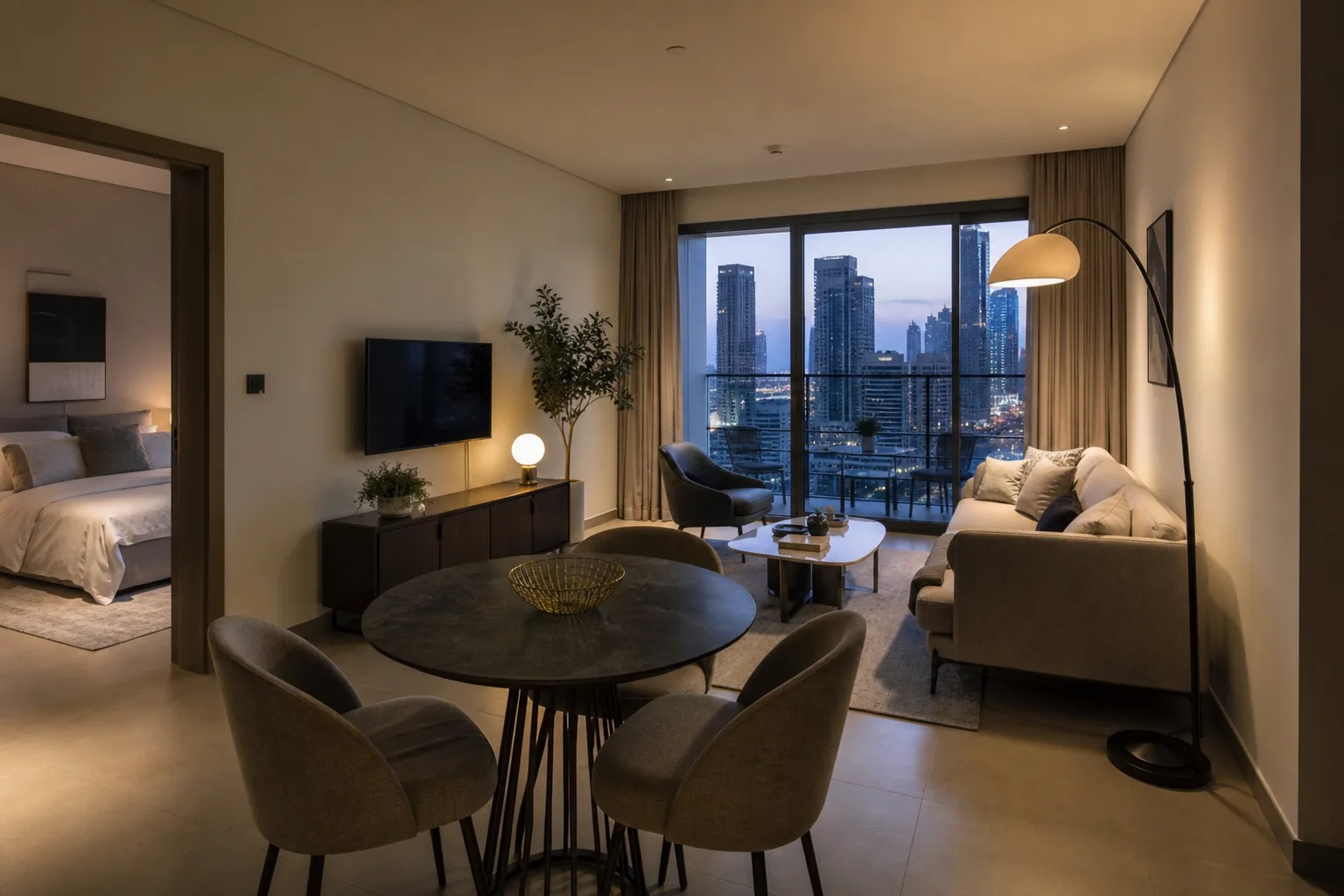
This rent is not reduced by any income tax in Dubai. The pre-tax and post-tax figures are identical on the Emirati side: on every 100 AED of rent collected per square foot, all 100 stay in your pocket before management and maintenance costs.
These costs exist, but they are not taxes. Service charges range from ~3 to 30 AED/sq ft/year depending on the property type, regulated by RERA through the Mollak system (RERA / DLD Service Charge Index). They reduce the net yield — the detailed calculation is set out in our guide to rental management and charges.
The tax treatment stays the same whatever the district, but the yield changes. In Downtown Dubai, the calculated gross yield falls to 5.6% (3,454 AED/sq ft), and in Palm Jumeirah to 4.5% (4,336 AED/sq ft), according to Bayut data (March 2026). Same 0% tax, very different returns.
French tax resident: how are your Dubai rents treated in France?
For a French tax resident, property income sourced in the Emirates is taxable in the UAE under the France–UAE tax treaty signed on 19 July 1989, according to the BOFiP. The local 0% exemption therefore combines with a precise treaty rule on the French side.

Featured
View projects: Dubai Harbour Residences
From AED 7,168,667
Hand-picked new properties with end-to-end expert support.
View projects
Double taxation is eliminated through a tax credit equal to the French tax: the French tax due on these rents is neutralised, but the income is taken into account to determine the effective tax rate applied to your other income.
This effective-rate mechanism means your Dubai rents, without being taxed themselves, can raise the rate applied to income that remains taxable in France. The principle is simple to state, more subtle to apply depending on each situation.
Why Dubai has no rental income tax: the framework behind it
The absence of rental income tax stems from the UAE's tax regime: 0% personal income tax, anchored in the official UAE government portal. The corporate tax, which came into force in June 2023, did not change this principle for individuals.

A project in mind?
Talk to a Lucretia adviser
Tailored guidance, no obligation.
This regime comes with an ownership framework that makes investing accessible to foreigners. Full ownership (freehold) has been open to non-nationals in designated areas since 2002 — a framework detailed in our guide to freehold in Dubai.
The rental market is also regulated. Service charges are overseen by RERA through Mollak, and off-plan projects have been protected by mandatory escrow accounts since Law No. 8 of 2007 (Dubai Land Department).
This 0% regime also feeds a residency strategy: a property investment of at least 2M AED grants entitlement to the 10-year Golden Visa, according to the official UAE portal. The conditions are set out in our guide to the Golden Visa through real estate.
What the landlord still has to budget for: real costs and levies
None of these items is a tax on rent, but all weigh on the real return. The first is the entry cost: the transfer fees at the Dubai Land Department come to 4% of the purchase price, plus fixed fees of around 4,700 to 5,500 AED (title deed, plan fees, trustee office) according to Property Finder.

On the secondary market, the buyer also pays agency fees of 2% of the price plus 5% VAT, according to Property Finder. This 5% VAT applies to the agency service — not to residential rent, which stays at 0% VAT according to the Federal Tax Authority.
Then comes the recurring annual cost, which varies by property type:
| Property type | Service charges (AED/sq ft/year) |
|---|---|
| Apartments | ~10 to 20 |
| Luxury towers | 20 to 50+ |
| Villas | ~2 to 6 |
These amounts, regulated by RERA, reduce the net collected. How to factor them into the cash-flow calculation is detailed in our guide to rental management. The takeaway: charges and fees are not taxes, and the tax on rent itself stays at 0%.
Points to watch and pitfalls of rental income tax in Dubai
The first pitfall of "zero tax" plays out from abroad: a French tax resident remains subject to the filing obligation and the effective rate set by the 1989 treaty. The local exemption does not remove the need to declare — the supporting documents to keep are covered in our taxation guide.

Free resource
Get our investment guide
The essentials — strategy, taxation, steps — to download.
Second point: short-term letting does not follow the same regime as long-term residential. It can fall under 5% VAT and specific permits, whereas long-term residential stays at 0% VAT. This mode of operation is covered in our guide to rental management.
Third pitfall: holding through a company can bring the income within the scope of corporate tax above 375,000 AED of profit, unlike ownership in your own name. A trade-off to frame upfront, developed in the taxation guide.
Among my clients, the most common mistake is not miscalculating the local tax — it's zero — but forgetting that their tax residence continues to follow them. We lock that down before buying, not after the first rent cheque.
— Benoit CLAUDEL, Director of Strategy & Operations
A final point, succession: by default, Sharia law may apply, and a will registered with the DIFC Wills secures the transfer for non-Muslims, according to the DIFC Courts. An estate-planning matter to anticipate, addressed in our taxation guide.
This article is part of our guide
Dubai Property Investment Guide for Foreign Buyers
About the author

Benoit CLAUDEL
Director of Strategy & Operations
With over 18 years of experience in real estate and wealth management, Benoît has developed recognized expertise in advising private investors, business executives and family offices. After starting out in a real estate agency and working within one of the most reputable wealth management firms in Paris, he then joined LCL as Head of Private Banking for Île-de-France, advising high-income clients on their real estate strategies. An entrepreneur, he founded and ran his own wealth management firm for 7 years, structuring investment and wealth optimization solutions. Today at Lucretia, Benoît oversees operational strategy, sales performance and advisor training. He works on high-value-added cases, particularly investments via French holding companies, legal structuring and wealth taxation.