
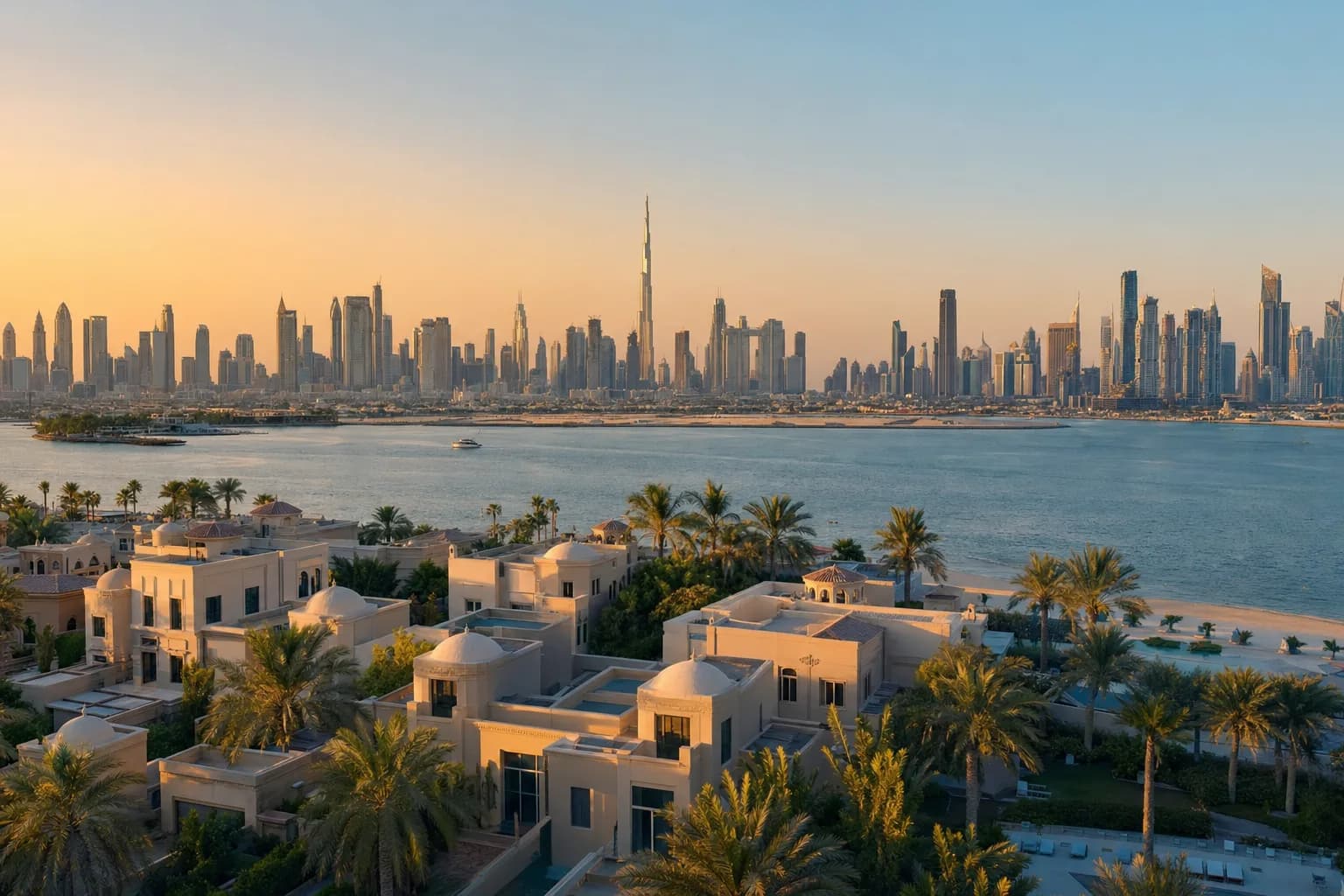
A non-resident finances in practice 50 to 75% of a Dubai property: here's the down payment to plan for, the fees to cover in cash and how the mortgage works.
On this page
- Mortgage and down payment for non-residents in Dubai: how much do you really need to finance?
- How much you actually pay out: a worked example of non-resident financing
- Bank mortgage or developer payment plan: how to finance according to the type of property?
- The framework that makes financing possible: freehold, status and currency
- What the loan costs beyond the rate: recurring charges to factor in
- Points to watch and pitfalls of non-resident financing
Property financing in Dubai for a non-resident covers in practice 50 to 75% of the property price depending on the bank, meaning a down payment of 25 to 50% to be drawn from your own funds (CBUAE Rulebook). A mortgage loan does exist for a foreign buyer with no local income, but on stricter terms than those offered to residents.
Understanding what the loan actually covers, what still has to be paid in cash and how the freehold framework makes borrowing possible avoids nasty surprises at signing. We break down every line item, figures in hand, and connect our clients with the banking partners who finance non-residents.
Mortgage and down payment for non-residents in Dubai: how much do you really need to finance?
The financed share varies from one bank to another, depending on the borrower's profile and the nature of the property. A non-resident sits within the 50 to 75% range mentioned above; our dedicated guide on the non-resident LTV and down payment sets out the bank conditions and the cash budget to plan for.

Be careful not to confuse two things. The Central Bank's regulatory cap applies to resident expatriates: 80% for a property at AED 5M or less, 70% above AED 5M, 60% for a second property, 50% off-plan. A non-resident, however, does not reach these ceilings: banks apply more cautious terms, hence the 25 to 50% down payment.
This is why many non-residents buy in cash: the capped financing makes the down payment heavy, and paying cash simplifies the file. Deciding between paying cash or taking a mortgage comes down to your capital, your status and your horizon, since cash maximises the yield you collect while borrowing multiplies the capital you can deploy. For those who want to spread the outlay without a bank loan, the developer's staged payment plan in off-plan offers another route.
How much you actually pay out: a worked example of non-resident financing
For an apartment in Business Bay, listed at AED 2,445/sq ft according to Bayut data (February 2026), an 800 sq ft home works out to roughly AED 1,956,000. The down payment and fees are calculated on this price.

Minimum down payment versus prudent down payment
With a non-resident LTV of 50 to 75%, the down payment falls between two bounds on this property at ~AED 1,956,000:
- Prudent down payment (50%): ~AED 978,000 of own funds, with the bank financing the other half.
- Minimum down payment (25%): ~AED 489,000, if the bank grants the best financing rate.
On top of this down payment comes the non-financeable cash, due at signing:
- 4% DLD transfer fee: ~AED 78,240 on this price;
- fixed DLD fees: ~AED 4,700 to 5,500;
- agency fees of 2% + 5% VAT on the secondary market: ~AED 41,076, VAT included.
All told, these ancillary fees exceed AED 120,000, regardless of the down payment.
On a more modest budget, the logic still holds. The Coventry Curve 2 project (GFS Developments, in Dubai Industrial City) starts at AED 500,000: a 25% down payment amounts to ~AED 125,000, a 50% down payment to ~AED 250,000.
Bank mortgage or developer payment plan: how to finance according to the type of property?
The financing method depends directly on the type of property: a bank mortgage for a completed property, a developer payment plan for a new project. The two approaches are not calibrated the same way.
Free resource
Get our investment guide
The essentials — strategy, taxation, steps — to download.
For a completed secondary property, the bank mortgage remains the classic route, with the down payment discussed above. The bank values the property, approves the file, then releases the funds at transfer, in step with the wider resale buying process that runs from offer to title-deed registration at the DLD.
In off-plan, the regulatory LTV drops to 50%, which increases the bank down payment. The developer's staged payment plan then becomes the dominant alternative: a deposit of 5 to 20% at reservation (often 10-20%), sometimes preceded by a fixed booking fee of AED 20,000 to 100,000 before the SPA is signed. The funds paid are secured in a mandatory escrow account (Law No. 8 of 2007, RERA/DLD oversight), a mechanism we detail in the off-plan guide.
Among the payment-plan projects in our portfolio: The Archive (Imtiaz Developments, Dubailand Residence Complex) from AED 700,000, or Aspirz (Danube Properties, Dubai Sports City) from AED 900,000. The full journey, from reservation to handover, follows six steps we describe elsewhere.
The framework that makes financing possible: freehold, status and currency
A non-resident's financing rests first on freehold ownership, open to foreigners in Dubai's designated areas since 2002 (Dubai Land Department). Without this freehold status, neither the purchase nor the loan would be possible.
Featured
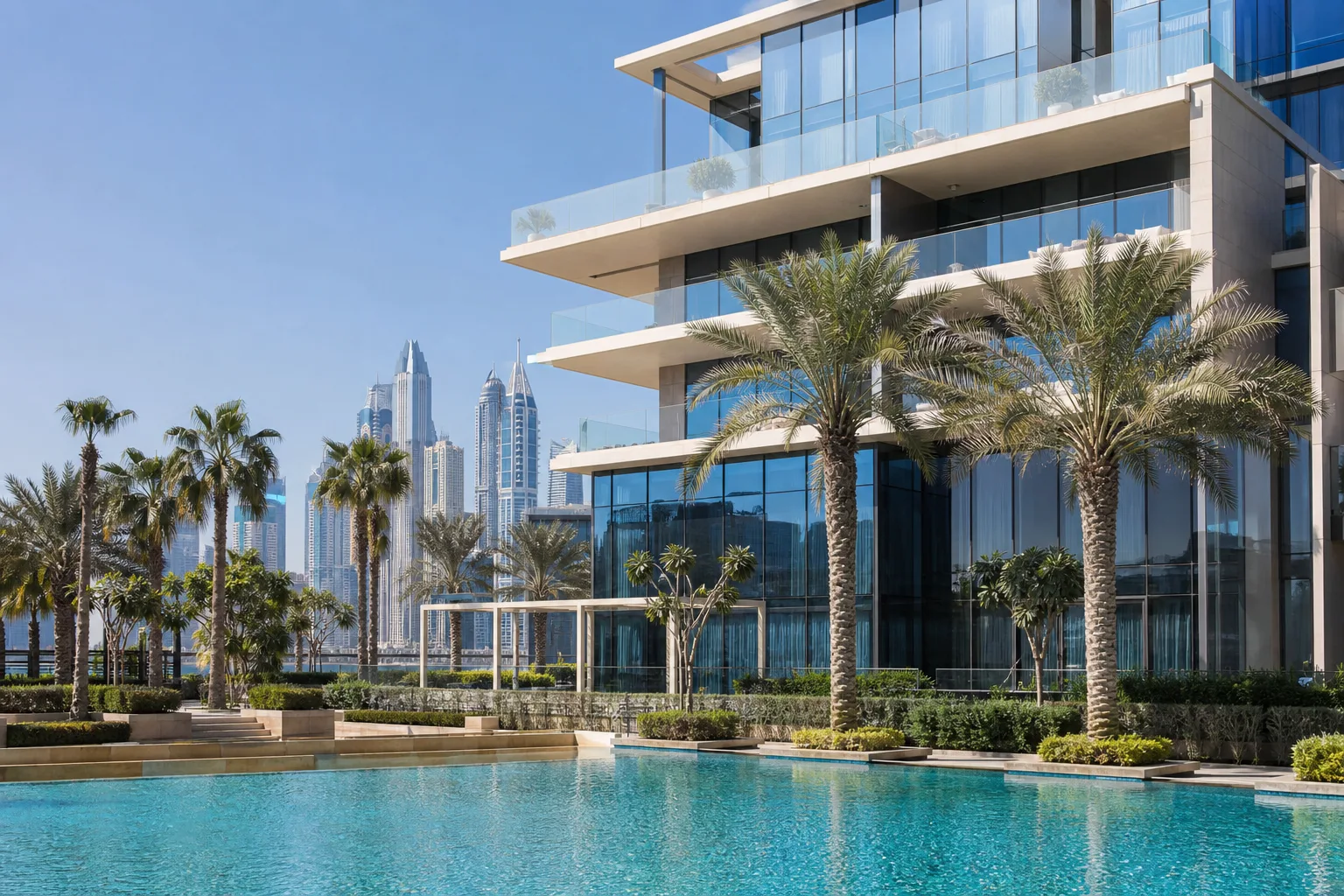
View projects: Keturah Reserve
From AED 3,871,000
Hand-picked new properties with end-to-end expert support.
View projects
The loan is taken out in dirhams (AED), a currency pegged to the US dollar. For an investor thinking in euros, this shifts the risk onto the EUR/USD exchange rate: the property value and the monthly payments track the dollar, a factor to build into your financing plan.
Aiming for this AED 2M threshold changes the balance between loan and down payment: the financed amount grows, so does the down payment. A buyer seeking both yield and residency weighs up a smaller property financed with a mortgage against a pricier one that triggers the visa. Our guides on choosing an investment help settle the question.
This legal security and the 0% tax that supports repayment are precisely what set Dubai apart from lifestyle-driven markets where ownership is more fragile: our comparison of investing in Dubai versus Bali weighs freehold and taxation against the very low ticket of alternative destinations, a useful lens before locking in a financing plan.
What the loan costs beyond the rate: recurring charges to factor in
Beyond the monthly payment, a financed property generates recurring annual charges: service charges range from ~3 to 30 AED/sq ft/year, regulated by RERA via Mollak (RERA / DLD Service Charge Index). Reckon on ~10-20 for an apartment, 20-50+ for a luxury tower, ~2-6 for a villa. These charges weigh on your repayment capacity and must enter the calculation from the outset.

Taxation, for its part, supports repayment. Individuals pay no tax on rental income or on capital gains (official UAE portal), and VAT on residential property is 0%. The rent collected therefore funds the monthly payment with no tax deduction.
This gross yield serves as a benchmark to cover the monthly payment plus service charges. But it remains gross: once charges, vacancy and the loan are deducted, net cash flow is thinner. Our guide on rental yield details this calculation, and the tax guide explains the shift to net cash flow.
Points to watch and pitfalls of non-resident financing
The first pitfall is confusing the CBUAE cap for residents with what a non-resident actually obtains. Budgeting a 20% down payment on the assumption of borrowing 80% means falling short: the 80% cap only applies to a resident.

A project in mind?
Talk to a Lucretia adviser
Tailored guidance, no obligation.
The second pitfall: forgetting the non-financeable ancillary fees. The DLD fees and agency fees detailed in the worked example do not fall within the loan. They inflate the upfront cash and must be provisioned from the very first simulation.
Among my clients, the most common mistake isn't choosing the wrong property, it's underestimating the cash to be mobilised on signing day. I always recommend costing out the down payment AND the fees before locking in a property.
— Manon TUIL, Real Estate Consultant
In off-plan, never pay funds outside the regulated escrow account, and keep in mind that the bank LTV there is capped at 50%. On the succession side, Sharia law may apply by default to an estate: a registered will (DIFC Wills or the Dubai courts) secures the transfer of a financed property.
One last snag: overestimating the loan's self-financing capacity. A district's advertised yield is not the actual monthly payment. Always weigh the expected rent against the full monthly cost before committing.
In this guide
Articles in this guide
This article is part of our guide
Dubai Property Investment Guide for Foreign Buyers
About the author