The property investment amount that unlocks residency in Dubai, threshold by threshold, with a worked example and the real budget needed beyond the purchase price.
On this page
- What investment amount unlocks which visa in Dubai?
- Reaching AED 2M in practice: a worked example on a real property
- The real budget to cross the threshold: what comes on top of AED 2M
- Does a mortgage count towards the threshold? Financing and the share you actually own
- Why Dubai links residency to property investment: the framework behind it
- Watch-outs and pitfalls around the AED 2M threshold
The Dubai Golden Visa property investment minimum is AED 2,000,000: that is the lowest value of one or more properties held in your name that triggers the 10-year property Golden Visa (Official UAE Government Portal). Below that level, other schemes exist with a lower threshold and a shorter term.
What counts is the value of the property you hold, never your nationality. Freehold ownership has been open to foreigners in Dubai's designated zones since 2002, and it is this ownership that underpins any residency-through-property strategy.
What investment amount unlocks which visa in Dubai?
In Dubai, a property investment of at least AED 2,000,000 unlocks the Golden Visa, a renewable 10-year residence permit, according to the Official UAE Government Portal. It is the value of the property or properties held in your name that determines access to residency.
This is not the same as simply owning property. Buying a freehold property in a designated zone — a right open to foreigners since 2002 according to the Dubai Land Department — makes you the full owner, but does not automatically grant 10 years of residency. Below AED 2M, you own a property; you do not get the long-term visa.
Several thresholds coexist, each with its own term:
| Scheme | Threshold | Term |
|---|---|---|
| Golden Visa | AED 2,000,000 | 10 years |
| Taskeen programme | AED 1,000,000 | 3 years |
Detailed eligibility, family sponsorship and renewal are a separate topic: our guide to the Dubai property Golden Visa covers them step by step.
Reaching AED 2M in practice: a worked example on a real property
To cross AED 2M with a single apartment in Business Bay, priced at AED 2,445/sq ft for sales in February 2026 according to Bayut data, you need roughly 818 sq ft — already a comfortable one-bedroom. Below that size, a single unit in this district won't reach the threshold.
Some premium districts clear the threshold with a modest floor area. On Palm Jumeirah, at AED 4,336/sq ft in March 2026 according to Bayut data, less than 500 sq ft already exceeds AED 2M. A new-build project such as Albero in Dubai Creek Harbour starts from AED 1.9M according to our catalogue: an amount to adjust slightly upwards to stay above the threshold.
Conversely, an affordable district demands a large floor area or several properties combined. In Arjan (AED 1,485/sq ft) or Dubai Sports City (AED 1,318/sq ft, March 2026, Bayut data), reaching AED 2M means more than 1,300 to 1,500 sq ft, or several units added together.
The real budget to cross the threshold: what comes on top of AED 2M
Beyond the price, crossing the AED 2M threshold means paying around AED 80,000 in transfer fees: the Dubai Land Department charges 4% of the purchase price, i.e. AED 80,000 on an AED 2M property, plus fixed fees of AED 4,700 to 5,500 (title deed, site plan fee, trustee office) according to Property Finder.
A project in mind?
Talk to a Lucretia adviser
Tailored guidance, no obligation.
On the secondary market, the buyer also pays the agency fee: 2% of the price plus 5% VAT, according to Property Finder. When buying off-plan directly from the developer, there is generally no buyer-side commission — a difference that weighs on the entry budget.
Good news on VAT: residential sales are zero-rated, according to the Federal Tax Authority. The AED 2M threshold is therefore not inflated by any tax on the home's price.
The line-by-line breakdown is in our guide to property buying costs in Dubai.
Does a mortgage count towards the threshold? Financing and the share you actually own
The threshold is assessed on the property's value, not on the money you pay out of pocket: an AED 2M property bought with a mortgage remains eligible, provided you supply a no-objection letter from the bank. Financing doesn't change your access to the threshold, but it does change the cash you need to commit.

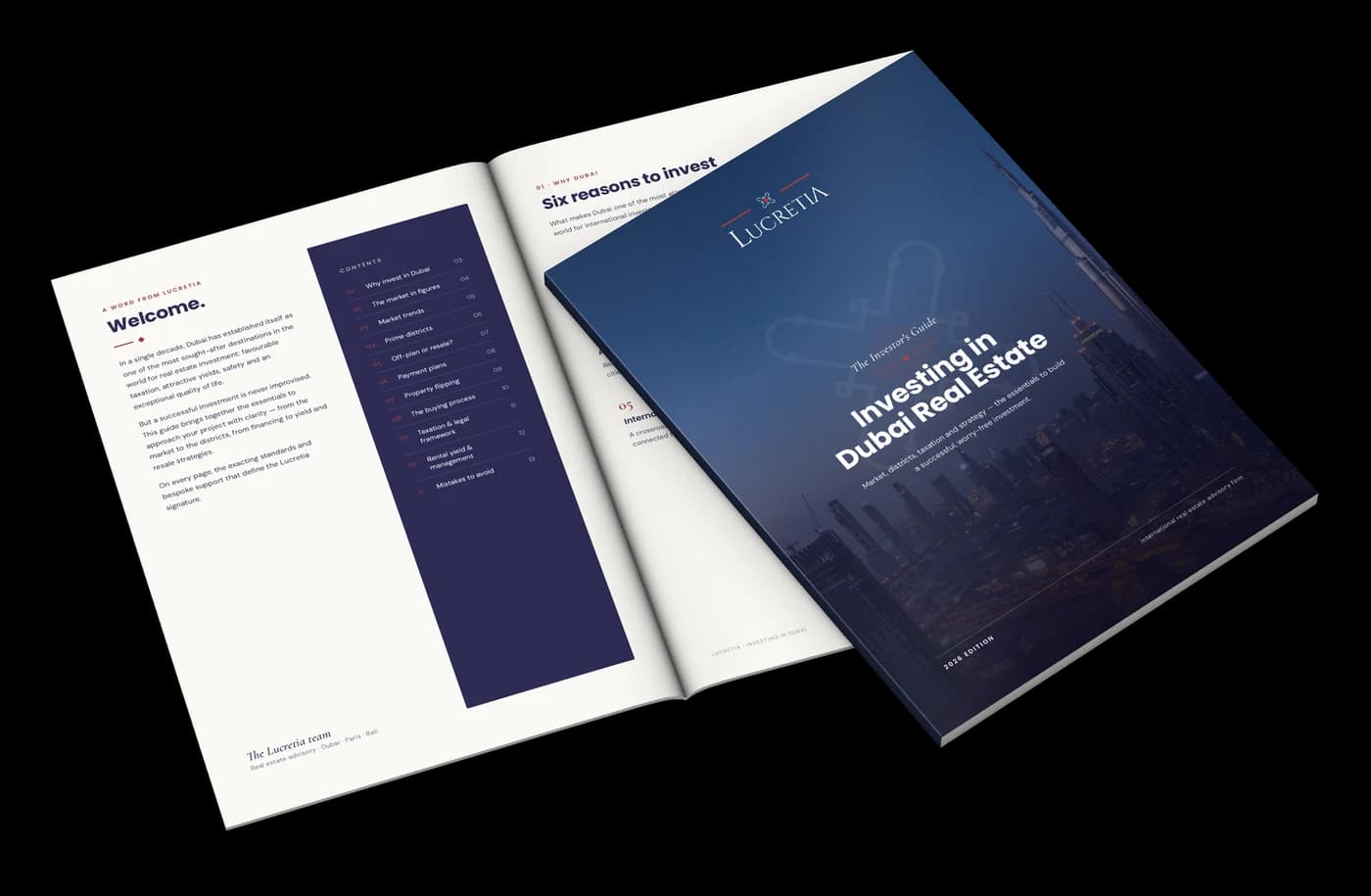
Free guide, delivered on WhatsApp
Get our investment guide
Taxation, visas, financing, buying steps: 14 pages sent to your WhatsApp within minutes.
Lending rules frame that cash requirement. The CBUAE caps borrowing for a resident expatriate at 80% of value (property ≤ AED 5M) and at 50% for off-plan. In practice a non-resident obtains 50 to 75% depending on the bank, meaning a down payment of 25 to 50% — a substantial upfront outlay on an AED 2M property.
Off-plan, you enter with a deposit of 5 to 20% on reservation, often 10 to 20%. These funds are held in a regulated escrow account, mandatory since Law No. 8 of 2007 under RERA/DLD supervision.
Mortgage terms for non-residents — rates, age limits, lenders — are covered in our guide to financing a property purchase in Dubai.
Why Dubai links residency to property investment: the framework behind it
Dubai has linked residency and property since freehold was opened to foreigners in designated zones in 2002 (Dubai Land Department): without this full-ownership right, no residency-through-purchase strategy would be possible. It is the cornerstone of the whole system.
Tax appeal goes hand in hand with residency. Individuals pay no tax on rental income or capital gains, according to the Official UAE Government Portal. The 9% corporate tax above AED 375,000, in force since June 2023, does not apply to property held in your own name.
For a French tax resident, the France–UAE treaty of 19 July 1989 eliminates double taxation through a tax credit on property income; this is covered in our guide to rental income in Dubai.
Finally, crossing the threshold is a strategic choice, not an obligation. The market median price stands at AED 1,883/sq ft according to Bayut series: an entry ticket well below AED 2M remains an option for anyone not targeting the long-term visa. You can compare options on our Dubai market page.
Watch-outs and pitfalls around the AED 2M threshold
The first pitfall is aiming right at the threshold: a property bought just under AED 2M does not qualify, and the value recognised by the DLD may differ from the negotiated price. Build in a margin above the threshold rather than an exact figure.
Threshold thinking often overlooks recurring costs. Service charges range from AED 3 to 30/sq ft/year, regulated by RERA via Mollak, and climb to AED 20-50+ in luxury towers according to the DLD Service Charge Index. This holding cost weighs on the property that carries your visa.
Returns depend heavily on the district chosen to reach the threshold: gross rental yield ranges from 5 to 8% by area (Bayut, 2025). A premium location like Palm Jumeirah sits below that range, around 4.5% gross, while an affordable district like Dubai Sports City (AED 1,318/sq ft, March 2026, Bayut data) sits at the upper end. Clearing the threshold and maximising yield don't always point to the same property.
The most common mistake I see among clients is sizing the purchase right at the threshold: the slightest valuation gap and the visa application stalls. I always prefer a property whose DLD-recognised value I can control.
— Benoit CLAUDEL, Director of Strategy & Operations
One last reflex: never mix the median price quoted in the press with Bayut's district-level prices in the same calculation — they are two distinct benchmarks. This is exactly the kind of judgement call we secure at Lucretia, steering the amount invested towards the right visa scheme.
This article is part of our guide
Dubai Property Investment Guide for Foreign Buyers
About the author

Benoit CLAUDEL
Director of Strategy & Operations
With over 18 years of experience in real estate and wealth management, Benoît has developed recognized expertise in advising private investors, business executives and family offices. After starting out in a real estate agency and working within one of the most reputable wealth management firms in Paris, he then joined LCL as Head of Private Banking for Île-de-France, advising high-income clients on their real estate strategies. An entrepreneur, he founded and ran his own wealth management firm for 7 years, structuring investment and wealth optimization solutions. Today at Lucretia, Benoît oversees operational strategy, sales performance and advisor training. He works on high-value-added cases, particularly investments via French holding companies, legal structuring and wealth taxation.