Local account or direct transfer, compliance file, exact amount to send, payment references, rental income: the five steps to move the money for an Abu Dhabi purchase safely.
On this page
- Abu Dhabi bank account and money transfers for buying property: the five-step route
- Step 1 — Open a UAE account or pay from your home bank?
- Step 2 — Which documents do you need to open an account and prove the source of funds?
- Step 3 — Working out the total to transfer: the price plus 2% in fees
- Step 4 — Making the transfer: to which account, with which references?
- Step 5 — Completing: paying the DARI fees and setting up rent collection
You don't need an Abu Dhabi bank account to buy property: an international transfer to the developer or seller is enough. You send the price plus the 2% property transfer fee (a registration charge, not to be confused with your bank's transfer fees), paid through DARI, the Abu Dhabi Real Estate Centre platform. A local account does become the natural tool, however, as soon as you rent the property out or move to the emirate.
What slows a purchase down is almost never the transfer itself. It's the source-of-funds checks, a name spelled differently from one document to the next, or a missing reference. Lucretia introduces you to its banking partners and secures every payment, from the first deposit to the collection of rent.
Abu Dhabi bank account and money transfers for buying property: the five-step route
The route comes down to five steps, for amounts ranging from AED 500,000 to AED 2M across the projects we select, with a median price of AED 1.5M.

- Choose your banking channel: a direct transfer from your own bank, or an account opened in the UAE.
- Prepare your file: identity, income and source of funds, before the first payment.
- Work out the total amount: the price and the property transfer fee, instalment by instalment.
- Make the transfers: right recipient, right references, proof kept.
- Complete and collect: fees paid at registration, then rent received locally.
This route applies to any foreign buyer: according to DARI, ownership is open to them in designated investment zones, a principle explained in our guide to the legal framework for foreign ownership.
Money flows sit within a wider timeline. For a completed property, they follow the property buying process. For new builds, they follow the steps for reserving and registering an off-plan property. The market as a whole is covered on our investing in Abu Dhabi page.
Step 1 — Open a UAE account or pay from your home bank?
You can pay from your home bank by direct international transfer. A UAE account adds convenience, but many banks require a minimum monthly balance and charge fees if it isn't maintained, according to the official UAE government portal.
- Direct transfer: no account to open or maintain. Each instalment, however, goes through a currency conversion and your own bank's checks.
- UAE account: you pay in dirhams from within the country and receive rent locally. You need to put together an account-opening file and meet the bank's conditions.
The deciding factor is your plan. A one-off purchase managed remotely works perfectly well by direct transfer. A long-term hold, with rent coming in and charges going out, justifies a local account.
For residents the case is even clearer. The 10-year Golden Visa is available from AED 2,000,000 of property investment, according to the Golden Visa page on u.ae: once you've moved, a local account becomes the hub of your financial life. Our guide to the property Golden Visa sets out the real budget.
If you borrow, the lending bank may ask you to open the account with them: see our guides on financing a purchase and mortgages for non-residents.
Step 2 — Which documents do you need to open an account and prove the source of funds?
According to u.ae, a standard account-opening file includes:

- passport, residence visa and Emirates ID;
- a salary certificate or employer letter;
- depending on the case, proof of address or, for the self-employed, a trade licence.
On timing, the Central Bank of the UAE (CBUAE) asks banks to aim to open accounts within 3 working days for low-risk customers with a complete file.
A project in mind?
Talk to a Lucretia adviser
Tailored guidance, no obligation.
Non-residents have neither a visa nor an Emirates ID: they provide a passport, proof of address abroad, recent bank statements and proof of income. Their file is scrutinised more closely, because the CBUAE regards non-resident account holders as harder to identify and the source of their wealth as harder to verify.
Proving the source of funds
Each source is backed by a document: statements for savings, a deed of sale for a property you've sold, a probate document for an inheritance. At the price points quoted above, these documents are always requested. If you buy through a company, the current anti-money laundering framework also requires the beneficial owner to be identified.
What I see most often with my clients: a source-of-funds file put together after the reservation, which holds up the first transfer. Prepare it while you're choosing the project.
Step 3 — Working out the total to transfer: the price plus 2% in fees
The amount to bring in is the property price plus the 2% property transfer fee, collected by ADREC via DARI.
Free guide, delivered on WhatsApp
Get our investment guide
Taxation, visas, financing, buying steps: 14 pages sent to your WhatsApp within minutes.

Applied to the price points in our catalogue, the calculation gives the following budgets:
| Price point (Lucretia catalogue) | Property transfer fee (2%, DARI) | Total to transfer |
|---|---|---|
| AED 500,000 (entry level) | AED 10,000 | AED 510,000 |
| AED 1.5M (median) | AED 30,000 | AED 1,530,000 |
| AED 2M (top of range) | AED 40,000 | AED 2,040,000 |
Take a real project. The Artery Residences, developed by IMKAN Properties on Reem Island, starts at AED 1.8M in our catalogue. The 2% fee adds AED 36,000, for a total of AED 1,836,000 to bring in.
On a new build, this budget doesn't go out in one go. You split it between the deposit, construction-linked instalments and the balance, as explained in our guide to payment plans. Each line of the schedule then becomes a transfer to plan.
Step 4 — Making the transfer: to which account, with which references?
The transfer goes to the account shown on the developer's or seller's official documents, identified by its IBAN, which has been mandatory in the UAE since 2012 for all electronic payments, domestic and international, according to u.ae.
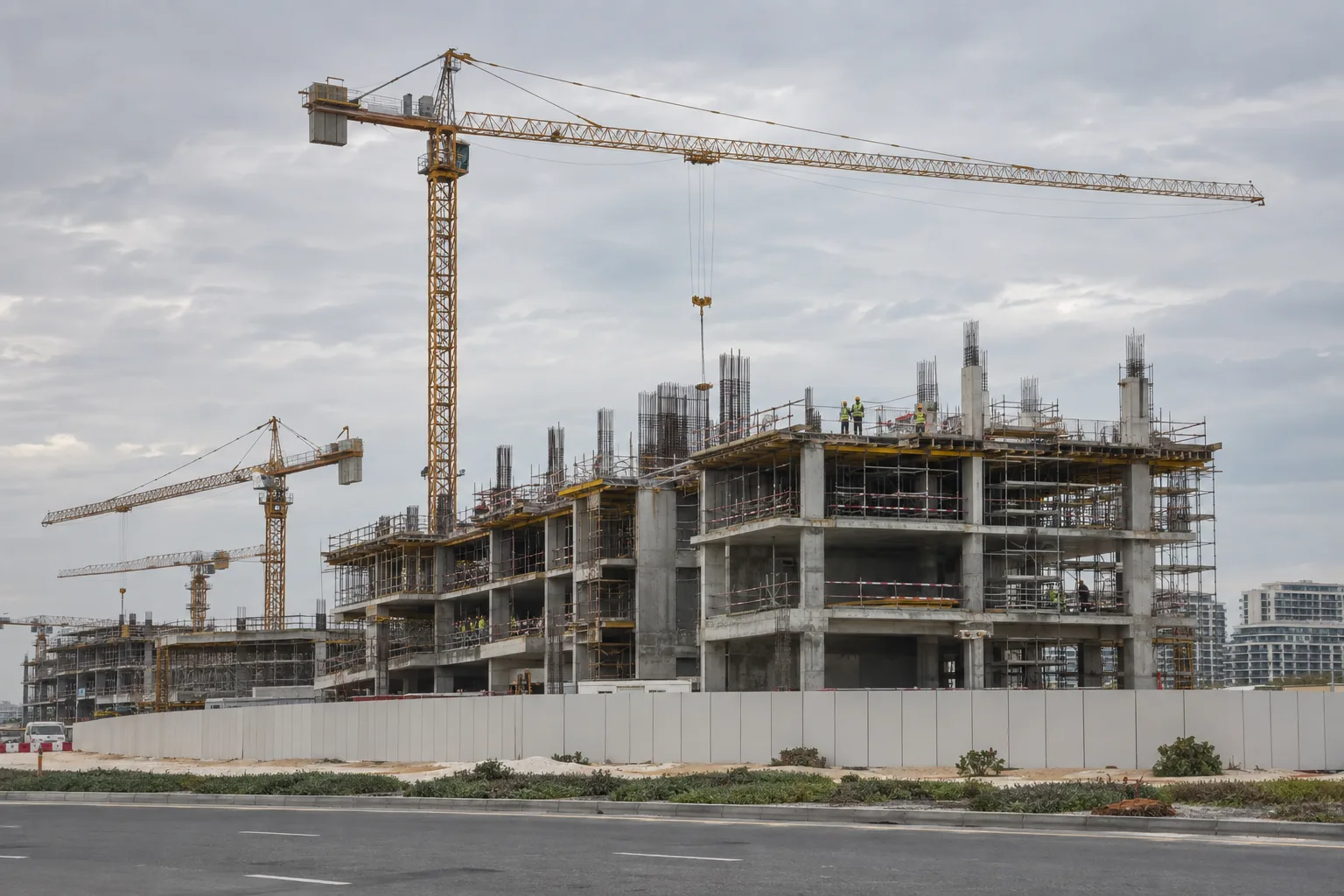
For an off-plan property, this is usually the project's escrow account (escrow). Check the IBAN against the one in the contract or payment notice, never against a simple message.
The payment reference identifies your transfer: project name, unit number, buyer's name. On Radiant Bridges, a Radiant project on Reem Island offered from AED 1.4M with handover in May 2029, the reference would read "Radiant Bridges", the apartment number and your name.
On the developer side, I've seen transfers arrive without a unit number: the accounts team then has to track down the buyer, and the receipt is delayed accordingly.
— Belen ALBA, Real Estate Consultant
Keep every transfer confirmation and every receipt. They are used at registration and prove the amount invested if you're aiming for the Golden Visa threshold. Finally, send each sum when it falls due rather than all at once: you stay in control of your cash flow.
Step 5 — Completing: paying the DARI fees and setting up rent collection
The last payment of the purchase is the property transfer fee calculated in step 3, settled at registration. It's also the moment to reconcile all your receipts with the total actually paid.

Any gap between your transfer confirmations and the amounts acknowledged by the developer is resolved before signing, not after. Insist on a fully settled buyer statement of account.
The local account then takes over for rent. On Reem Island, rent reaches AED 102/sq ft/year according to Bayut data (March 2026), for a calculated gross yield of 6.8%, before charges and vacancy. That rent arrives in dirhams, with no intermediate conversion.
Money you send home faces no withholding locally: individuals in the UAE pay no tax on rental income or capital gains, according to the taxation page on u.ae. Our guide to property taxation in Abu Dhabi explains the scope.
The same account pays recurring costs by direct debit: property manager fees, covered in our guide to rental management, and building charges, detailed in our guide to service charges. Lucretia sets up these flows with you from handover, as part of our advisory services.
This article is part of our guide
Abu Dhabi Property Investment Guide: Buy, Let and Resell with Confidence
About the author

Belen ALBA
Real Estate Consultant
With experience in Dubai's real estate market and an international background between Brussels and Dubai, Belen brings a 360° vision of the sector. After working for more than a year within a well-known developer, she supported both investor clients and partner agents, giving her a unique inside view of the sales process and off-plan projects. Multilingual (French, Spanish, Portuguese and English), Belen knows how to naturally connect with clients from all over the world. Her approach: direct, transparent and results-oriented — with a genuine passion for helping each client make the right investment at the right time.