Buying to resell in Dubai means thinking net of costs: here are the three profit levers, a worked example, and the pitfalls that wipe out a gain made too soon.
On this page
- How to make a profit flipping property in Dubai: the levers that set the price
- Worked example: what net capital gain on a Dubai resale?
- Off-plan or completed property: which resale strategy to choose?
- Which districts have the best resale capital gain potential?
- The framework that secures a buy-to-sell deal
- Watch points and pitfalls of property flipping in Dubai
When property flipping in Dubai, an individual's capital gain is not taxed: the capital gains tax rate is 0% for private individuals (official UAE government portal). That gross gain, however, only turns into real profit once the entry and exit costs of both transactions have been deducted.
Capital gains are built on gaps between districts, not on the market average. Understanding where and when value is created, and how much fees eat into the result, is what separates a profitable deal from a flip that costs more than it returns.
How to make a profit flipping property in Dubai: the levers that set the price
Property flipping in Dubai comes down to resale price minus purchase price minus entry and exit costs — and for a private individual, that gain is not taxed (0% on capital gains, UAE government). Buy-to-sell, or a flip, means buying, adding value or waiting for appreciation, then reselling.
Three levers produce that gain, and they need to be kept clearly apart:
- Market appreciation: holding a property and letting the price per square foot rise over time.
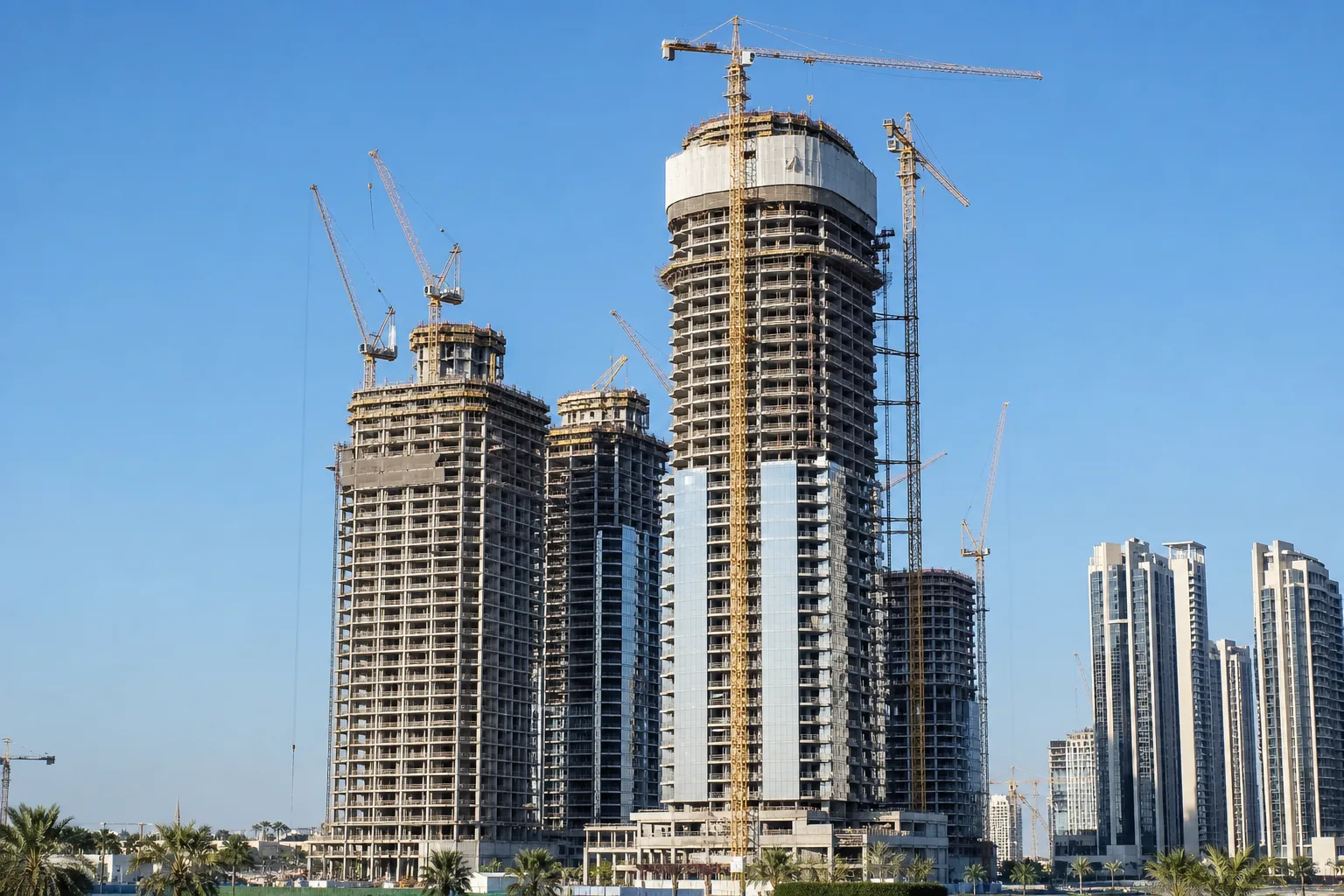
- The off-plan flip: buying off-plan and reselling on or after handover, once the property has gained value between launch and key handover.
- Renovation or repositioning of a secondary-market property, creating value through work rather than time.
The market's anchor figure remains modest: the median movement is +2.6% over 12 months across 71 districts, for a median price of AED 1,883/sq ft, according to Bayut data. Capital gains, then, aren't made on the average, but on the gaps between districts.
Worked example: what net capital gain on a Dubai resale?
A gross gain of several dozen percent per square foot melts away once fees on both sides are deducted. Take an off-plan flip on The Archive, in Dubailand Residence Complex, listed from AED 700,000 in our catalogue.
The district rose +3.4% over 12 months and +61% over 36 months according to Bayut data (March 2026). Over a three-year horizon, a valuation of that order turns an AED 700,000 entry price into a clearly higher resale — but fees come into play on both sides.
The costs that eat into the gain
- On an off-plan purchase from the developer: usually no commission on the buyer's side, but registration with the Dubai Land Department still applies — 4% of the price, plus ~AED 4,700 to 5,500 in fixed fees (Property Finder). On AED 700,000, the 4% comes to AED 28,000.
- On exit or for a secondary-market purchase: 2% agency fees + 5% VAT on that commission (Property Finder), payable by the buyer on the secondary market.
The district effect is decisive. Over 60 months, Jumeirah Garden City shows +147.6%, while Palm Jumeirah rises +69.1% (Bayut data, March 2026). Same calculation method, very different results — our guide to which Dubai areas appreciate most maps out these five-year gaps district by district.
Net capital gain works out like this: (resale price − purchase price) − entry costs − exit costs. It's that balance, not the headline rise, that measures the success of the deal.
Off-plan or completed property: which resale strategy to choose?
Three strategies lead to capital gains, each with its own horizon and risk profile. The choice depends on your ability to tie up capital and your tolerance for building sites. Before comparing them, it helps to weigh the underlying trade-off between buy-to-let or resale in Dubai, since collecting steady rent and capturing appreciation answer to two opposing logics.
Free resource
Get our investment guide
The essentials — strategy, taxation, steps — to download.
The off-plan flip
Buying off-plan with a deposit of 5 to 20% of the price (often 10–20%, SBA/Grosvenor market sources), then reselling before or at handover. The capital committed upfront is low, which amplifies the return on the gain. The full process, from reservation to key handover, is set out in our guide to buying off-plan step by step.
Buy & hold for appreciation
Holding a completed property and playing the long appreciation game. The 36- and 60-month series show the scale possible: Dubai Silicon Oasis shows +108.9% over 60 months (Bayut data, March 2026). This strategy also collects rent during the holding period.
Reselling on the secondary market
Reselling a completed property means mastering the mechanics of the NOC and the Form F, covered in our guide to buying on the secondary market. The key issue here is exit timing — our guide on when to sell your Dubai property lays out the signals to cross-check before pulling the trigger.
Financing changes the equation: a non-resident in practice secures 50 to 75% of the price in credit, with off-plan capped at 50% (CBUAE Rulebook). The detailed terms are in our guide to financing for non-residents.
Which districts have the best resale capital gain potential?
Districts in a catch-up phase often offer stronger appreciation than areas that are already mature. Over 60 months, Dubai Industrial City shows +132.1%, against +64.9% for Business Bay, an already established district (Bayut data, March 2026 and February 2026).
A project in mind?
Talk to a Lucretia adviser
Tailored guidance, no obligation.
To fine-tune your purchase timing, recent 12-month dynamics give the pulse of the market:
| District | 12-month change | Calculated gross yield |
|---|---|---|
| Bukadra | +12.2% | 3% |
| Dubai Silicon Oasis | +5.7% | 6.3% |
| Dubai Industrial City | +5.6% | 5.3% |
A district with strong appreciation isn't necessarily the most profitable to rent out: Bukadra rises fast but shows only 3% calculated gross yield (Bayut data). This trade-off between capital gain and rent is worth weighing against your objective — our guide to choosing the right district and the one on rental yield spell it out.
On the ground, I see plenty of buyers rushing into the district that climbed the most last year. That's often a sign the rise has already happened: capital gains are set up by buying before the catch-up, not after.
The framework that secures a buy-to-sell deal
Reselling freely first requires being a full owner, which is what freehold guarantees — open to foreigners in Dubai's designated areas since 2002 (Dubai Land Department). The boundaries of these areas are set out in our guide to the legal framework of property ownership.

Off-plan, funds are protected by mandatory escrow accounts (Law No. 8 of 2007, RERA/DLD supervision, per the DLD). This safeguard applies even before resale: your capital stays locked in a regulated account until construction milestones are met.
The choice of developer weighs heavily on the liquidity of an off-plan flip. Players such as Emaar Properties, DAMAC Properties or Binghatti Developers naturally draw a wider pool of buyers at resale.
Watch points and pitfalls of property flipping in Dubai
The first pitfall is double-transaction fees: paying 4% DLD transfer fees, plus fixed fees, plus 2% agency + VAT on purchase, then fees again on exit, can wipe out a short gain. On a gross rise of a few points, the net balance quickly turns negative.

The second pitfall is headline valuation in gross terms. During the holding period, service charges — AED 3 to 30/sq ft/year, regulated by RERA via Mollak (DLD Service Charge Index) — erode your carry year after year.
The third pitfall is residence-country taxation. Dubai's 0% doesn't necessarily apply in your own country: the 1989 France–UAE treaty eliminates double taxation through a tax credit, but how it applies depends on your situation (BOFiP). Our guide to property taxation clarifies this point, and the step-by-step Dubai resale and capital gains process details how the tax-exempt gain is realised at DLD transfer.
Among my clients, the most common mistake is reselling after just one year, euphoric over the price rise per square foot, without having worked out that the fees on both transactions weren't even covered.
— Ralph BERTUCCI, Consultant Manager
One last point: reselling too soon in a market at +2.6% median over 12 months won't cover the fees. And if the holding period stretches out, plan ahead for succession through a registered will (DIFC Wills, DIFC Courts). We support resales and off-plan contract assignments, with ground-level figures on fees and timelines.
In this guide
Articles in this guide
This article is part of our guide
Dubai Property Investment Guide for Foreign Buyers
About the author

Ralph BERTUCCI
Consultant Manager
With over 6 years of experience in real estate, notably as a property trader, Ralph is a key expert at Lucretia. His keen eye and attention to detail make him a valuable ally for investors in Dubai. Passionate about his profession, he puts his expertise at the service of his clients, offering strategic advice and guiding them toward the best opportunities on the market, while ensuring their profitability is maximized.